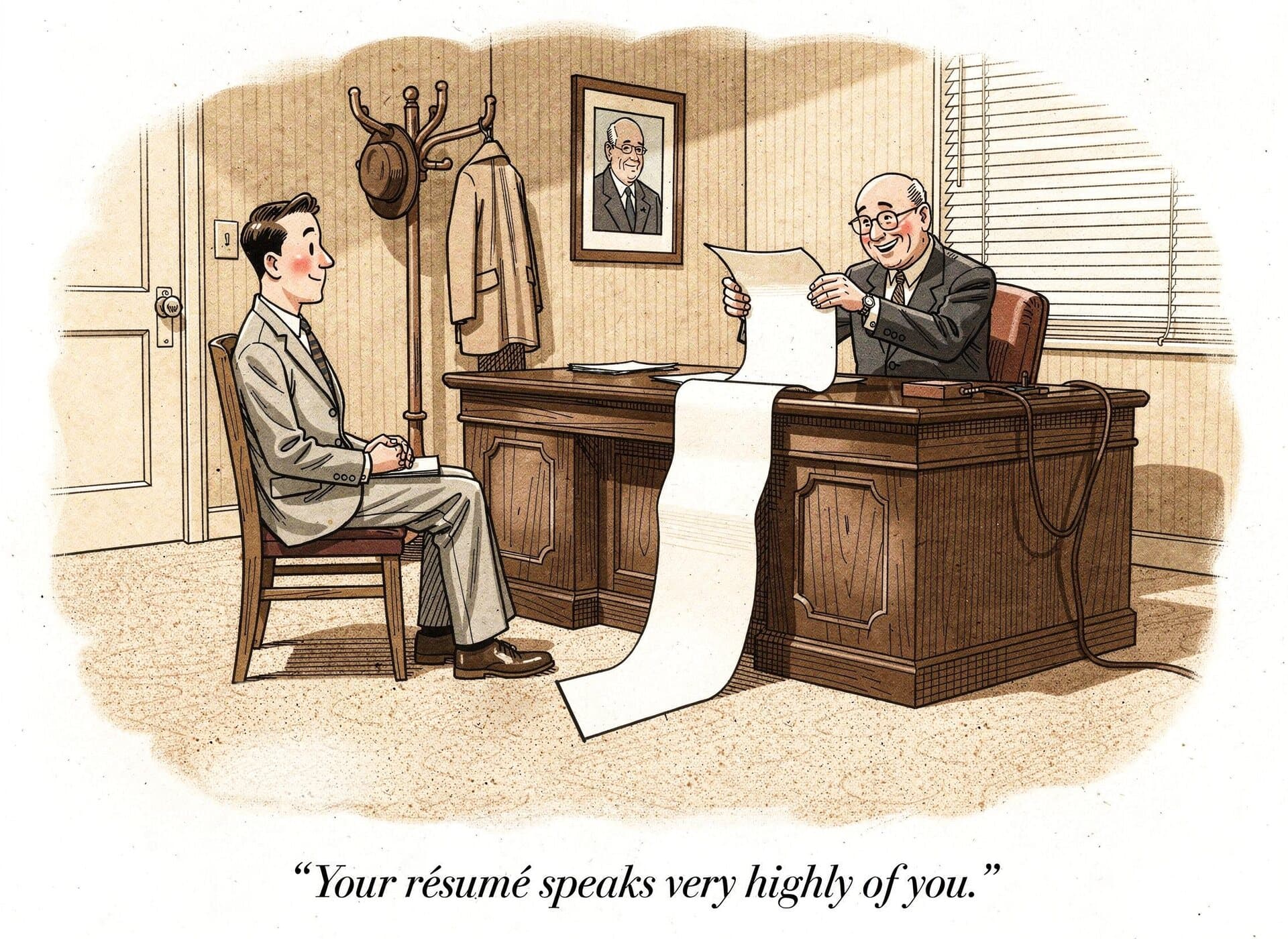
A résumé is an argument. It is a carefully constructed case for why a candidate deserves a seat at the table — one they have edited, refined, and often had professionally polished before it reached you. As an interviewer, you are not reading a biography. You are reading a sales document. The question is whether you know the difference.
That distinction matters because the qualities that matter most over a career — perseverance, integrity, adaptability, genuine regard for the people around them — do not appear in bullet points. They show up, or fail to show up, in how a person navigates difficulty, how they treat others when no one is keeping score, and how they respond when things do not go as planned. None of that is on the page. And the instrument most of us use to find it — an open-ended conversation and a gut read — is among the least reliable we have. The answer is not to stop looking for character. It is to look for it with structure.
Talent Doesn't Follow a Pedigree
Life does not deal everyone the same hand. Some people have a clear path — supportive families, strong schools, networks that open doors before they even need to knock. Others have to forge their own way entirely, building through setbacks what others inherited through circumstance.
A privileged background can open doors. It does not guarantee the capacity to walk through them well. And the absence of privilege says nothing about talent — it may, in fact, have produced something more durable. Many of the most capable people I have worked with arrived by unconventional routes. What they shared was not pedigree; it was a quality that researchers have taken to calling grit: perseverance and passion directed toward long-term goals.
Psychologist Angela Duckworth's research on grit, published in the Journal of Personality and Social Psychology, found that this trait predicted success across remarkably varied contexts — from West Point cadets completing their grueling first summer of training to Ivy League undergraduates to National Spelling Bee finalists. Among the cadets and the undergraduates, grit predicted outcomes over and above measured ability — SAT scores and West Point's admissions composite.1 Grit, in Duckworth's framing, is not intensity or ambition. It is the willingness to keep going, keep learning, and stay connected to a goal over years, not just weeks.
The finding deserves a caveat. A later meta-analysis of nearly 67,000 people found grit's link to performance more modest than the early coverage suggested, and found that it overlaps heavily with conscientiousness; the perseverance half of grit carried most of its predictive weight.2 That is a reason to look for perseverance specifically — not to treat grit as a magic number.
Perseverance rarely appears in a job title. But it reveals itself in other ways — if you know how to look.
Every Résumé Tells a Story — But Not the Whole One
A résumé is designed to highlight strengths and minimize weaknesses. Understanding this is not cynicism; it is simply reading carefully.
I was reminded of this years ago when I helped a friend prepare an application for a flight attendant position. She had considerable experience — including time managing a franchise location — but we made a deliberate choice to lead with her years as a kindergarten teacher instead. Not because the management experience was irrelevant, but because the teaching role painted a more honest picture of who she was for that particular job: someone patient, warm, accustomed to handling the unpredictable with composure. Both versions of her résumé were accurate. Neither was complete.
As an employer, your task is to find the rest of the story — the parts that didn't make the cut, the difficulties navigated quietly, the growth that doesn't come with a job title. That requires conversation, not just scanning.
The Limits of Instinct
There is a version of hiring wisdom that places heavy emphasis on gut feeling — the sense that you simply know when someone is right. I understand the appeal. Experience does sharpen perception, and pattern recognition is real.
But it is worth being honest about what "gut instinct" in a hiring context can actually represent. Research on unstructured interviews — the kind where conversation flows freely without consistent questions or scoring criteria — consistently finds that they are among the weaker predictors of actual job performance. The most recent large meta-analysis puts their validity at less than half that of structured interviews, which ranked as the single best predictor studied.3 When we feel an immediate, unexplained affinity with a candidate, we are sometimes recognizing genuine qualities. We are also sometimes recognizing familiarity: shared background, similar communication style, the simple comfort of talking to someone who reminds us of ourselves. In one study of elite law, banking, and consulting firms, evaluators consistently favored candidates who resembled them in leisure pursuits, experiences, and self-presentation.4
This is not an argument against intuition. It is an argument for giving intuition a better foundation. The most reliable instincts are the ones that have been tested against consistent, structured observation — not first impressions formed before the candidate has finished their opening sentence. Even experienced evaluators predict performance less accurately when they weigh the evidence by feel rather than by a consistent rule.5
What to Actually Look For
Building a strong team means developing the discipline to look past surface presentation and ask more deliberate questions.
Communication is not fluency or polish — it is the ability to adapt a message to the person receiving it. A candidate who explains a complex idea differently to a technical colleague than to a new team member is demonstrating something genuinely valuable. Watch for that flexibility.
Problem-solving reveals itself not in a candidate's answer, but in their process. How do they think out loud? Do they acknowledge uncertainty, or paper over it? The willingness to say "I'm not sure, but here's how I'd approach finding out" is often more telling than a confident but brittle answer.
Empathy and collaboration are harder to surface in an interview, but not impossible. Ask about a time they helped someone else succeed, then listen for whose name appears most often in the story. People who genuinely care about their colleagues tend to remember the contributions of others clearly.
Resilience shows up in how someone speaks about past failures. Blame, resentment, or an absence of reflection are signals worth noting. So is the opposite: someone who has clearly learned something specific and durable from a setback, and can articulate what it was.
Self-awareness is often visible in how a candidate receives a gently probing follow-up question. Do they become defensive, or do they lean in? Are they open to the possibility that their own account of events is incomplete?
Integrity is the foundation beneath all of these. It does not announce itself, but it shows in whether someone owns their mistakes, speaks plainly about their limitations, and demonstrates the same care for others in small moments as in large ones.
None of these qualities fit neatly into a bullet-point checklist — but the questions that surface them should. Write the probes down and ask every candidate the same ones. Before the interviews begin, agree on what a strong answer and a weak answer sound like for each. Have every interviewer score each answer on their own, before the panel compares notes, so the most confident voice in the room does not become the verdict. None of this requires an interrogation. A conversation can be unhurried and warm and still be structured; the structure is what lets you trust what you heard.
Build a Team That Lasts
The most durable teams are not assembled by collecting impressive credentials. They are built by bringing together people with diverse paths and genuine strengths — people whose values align with the organization's, and who will reinforce the culture in the moments when the leader is not in the room.
When you prioritize integrity, curiosity, and perseverance over pedigree, you do not lower the bar. You raise it to where it actually matters. A résumé can tell you where someone has been. Only a thoughtful conversation will begin to tell you what they are made of — and whether, given the chance, they will grow into something greater than the role you are filling today.
Footnotes
-
Angela L. Duckworth, Christopher Peterson, Michael D. Matthews, and Dennis R. Kelly, "Grit: Perseverance and Passion for Long-Term Goals," Journal of Personality and Social Psychology, Vol. 92, No. 6 (2007), pp. 1087–1101. Grit predicted first-summer retention at West Point over and above the academy's admissions composite, and GPA among University of Pennsylvania undergraduates over and above SAT scores. Among National Spelling Bee finalists, grit predicted advancement, but not after controlling for verbal IQ. https://doi.org/10.1037/0022-3514.92.6.1087 ↩
-
Marcus Credé, Michael C. Tynan, and Peter D. Harms, "Much Ado About Grit: A Meta-Analytic Synthesis of the Grit Literature," Journal of Personality and Social Psychology, Vol. 113, No. 3 (2017), pp. 492–511. Pooling 88 samples (N = 66,807), the authors found grit only moderately correlated with performance and retention, very strongly correlated with conscientiousness, and driven mainly by its perseverance-of-effort facet. https://doi.org/10.1037/pspp0000102 ↩
-
Paul R. Sackett, Charlene Zhang, Christopher M. Berry, and Filip Lievens, "Revisiting Meta-Analytic Estimates of Validity in Personnel Selection: Addressing Systematic Overcorrection for Restriction of Range," Journal of Applied Psychology, Vol. 107, No. 11 (2022), pp. 2040–2068. Estimated operational validity: structured interviews .42, the highest of the predictors reviewed; unstructured interviews .19. https://doi.org/10.1037/apl0000994. The size of the paper's downward correction has been debated on method; see the authors' reply, "Correcting for Range Restriction in Meta-Analysis: A Reply to Oh et al. (2023)," Journal of Applied Psychology, Vol. 108, No. 8 (2023), pp. 1311–1315, https://doi.org/10.1037/apl0001116. See also: Google re:Work, "A guide to structured interviewing for better hiring practices": https://rework.withgoogle.com/intl/en/guides/a-guide-to-structured-interviewing-for-better-hiring-practices ↩
-
Lauren A. Rivera, "Hiring as Cultural Matching: The Case of Elite Professional Service Firms," American Sociological Review, Vol. 77, No. 6 (2012), pp. 999–1022. Based on 120 interviews with evaluators and participant observation of a hiring committee. https://doi.org/10.1177/0003122412463213 ↩
-
Nathan R. Kuncel, David M. Klieger, Brian S. Connelly, and Deniz S. Ones, "Mechanical Versus Clinical Data Combination in Selection and Admissions Decisions: A Meta-Analysis," Journal of Applied Psychology, Vol. 98, No. 6 (2013), pp. 1060–1072. Combining candidate information holistically, even by experienced practitioners, consistently lost predictive validity compared with mechanical (rule-based) combination. https://doi.org/10.1037/a0034156 ↩