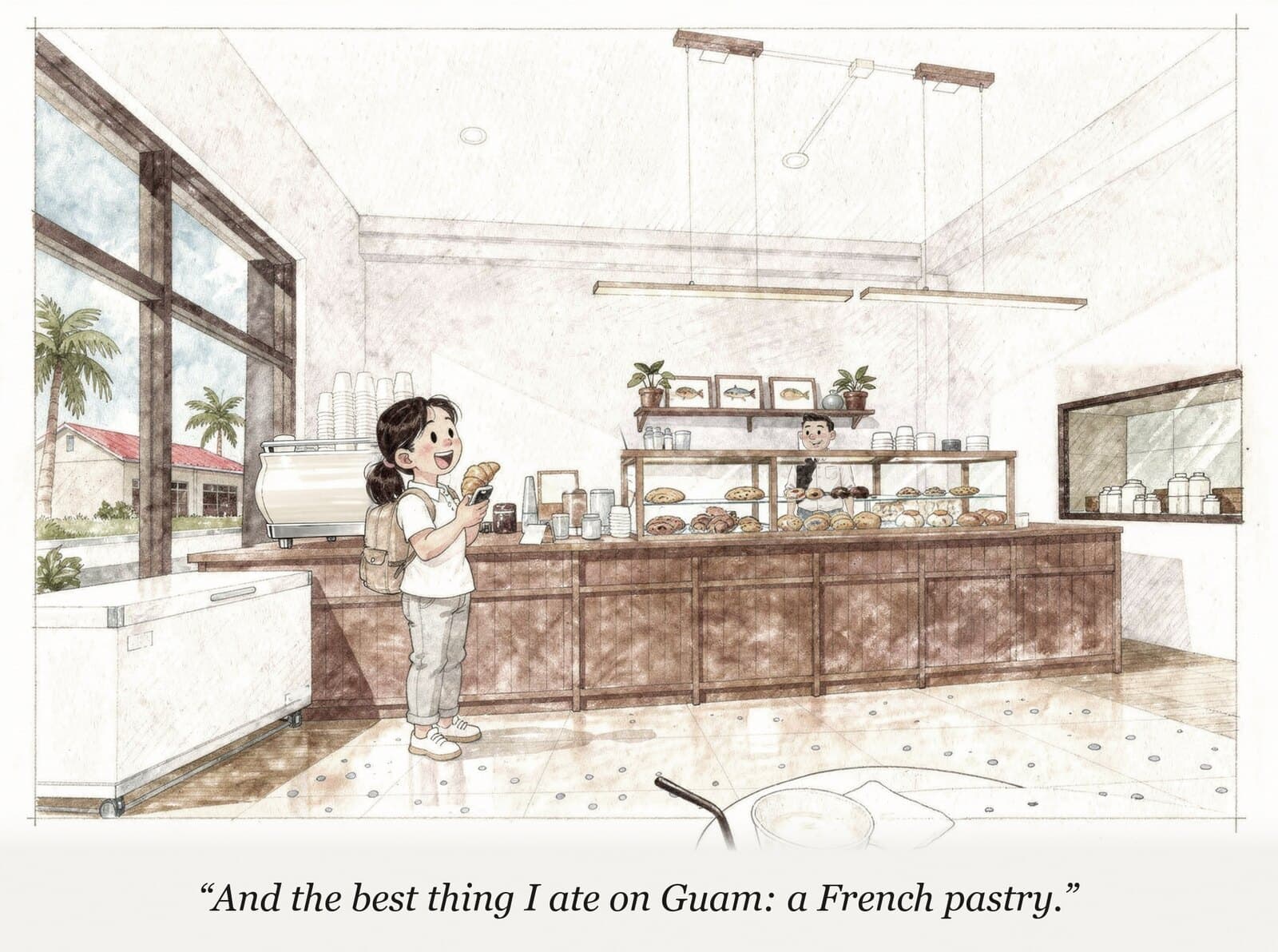
Imagine a Korean cooking show — one of those wildly popular ones with millions of viewers — filming an episode on Guam. The host discovers a dish born from the island's Chamorro roots, developed with local ingredients, cooked on a beach at sunset. The episode airs. Forty million viewers watch. And suddenly, Guam is not just a beach destination. It is a place with a flavor. A story. A reason to go back.
That is not a fantasy. It is a strategy — one Guam has yet to try.
The Awkward Truth
Not long ago, I heard a former Guam resident describe the food they missed most after leaving the island. Their answer was not kelaguen. Not red rice and barbecue at a family fiesta. It was the fried chicken and mashed potatoes at a fast food chain.
That small admission is not an insult to Guam. It is a diagnosis.
Ask most visitors what they ate here and they will describe a hotel buffet, a chain restaurant in Tumon, or a meal indistinguishable from something they could have ordered back home. The island's Chamorro food traditions — shaped by centuries of Spanish, Filipino, and Micronesian influence, and genuinely unlike anything else in the Pacific — are largely invisible to the average tourist. They exist, warmly and proudly, at family fiestas and a handful of local spots that visitors rarely find. But they have never been given a stage.
Guam is sitting on a culinary identity it has not yet introduced to the world.
The Numbers Tell an Uncomfortable Story
In calendar year 2024, Guam welcomed approximately 739,000 visitors — a 12.5% improvement over the prior year, according to a Tourism Economics report commissioned by GVB.1 But that figure is still only 44% of the 1.66 million who came in 2019.1 Visitor spending, meanwhile, remains nearly 40% below its pre-pandemic peak of $1.8 billion.1
Here is the part that should trouble us most: 78.9% of all arrivals came from just two countries — South Korea and Japan.1 Our entire tourism economy rests on a remarkably narrow base. And the two pillars long used to support it — duty-free luxury shopping and American brand dining — are visibly crumbling.
This month, T Galleria by DFS closes its doors for good after 55 years on Guam.2 The store that defined Tumon's skyline, that generations of Korean and Japanese visitors treated as a mandatory stop, is gone. It is not a minor inconvenience. It is a landmark erased. And DFS did not leave alone — Hard Rock Cafe Guam, a fixture since 1998, shut down permanently in November 2025 after 27 years.3 Tony Roma's, a family staple for four decades, served its final meal in August 2025, its owner citing the sustained decline in tourist traffic as the decisive factor.4 Caronel, Guam's authorized Rolex retailer, is also reportedly in the process of closing.2
Walk through Tumon today and the evidence is impossible to ignore. Guam Chamber of Commerce Chairman Tae Oh put it plainly: "DFS has always been an iconic landmark here on Guam. For them, it's one less thing to do."2 One less thing — and there were not that many things to begin with.
If visitors are coming primarily for shopping and American brand dining, we are now offering less of both. The old pitch is broken. And if Guam does not build something new to replace it, the island risks not just a slow recovery but a structural irrelevance in a region full of destinations that are actively reinventing themselves.
Food changes that equation. According to the World Food Travel Association's 2022 report, 34% of international tourists choose their destination specifically because of its cuisine.5 A peer-reviewed study in Tourism Management Perspectives found that iconic dishes do not just attract visitors — they bring them back.6 France, Italy, Vietnam, and Thailand have built unshakeable tourism brands around this principle. They are not selling scenery. They are selling a taste that you cannot get anywhere else.
Ask yourself: what taste does Guam own?
The Dish That Was Invented by a Government
Before you assume that building a culinary identity takes generations, consider this: Pad Thai — the dish most synonymous with Thailand, beloved by hundreds of millions of people worldwide — did not exist before the 1930s.
It was not handed down through centuries of Thai grandmothers. According to research published in Smithsonian Magazine, it was actively promoted — some historians say invented outright — by the Thai government under Prime Minister Plaek Phibunsongkhram.7 The context was equal parts wartime survival and nationalist ambition: a rice shortage, a propaganda campaign, and a standardized recipe distributed to street vendors across the country. The dish borrowed its technique from Chinese immigrants and its soul from Thai ingredients — tamarind, fish sauce, chili. A culinary icon, engineered on purpose.
Then in 2002, Thailand went further. The government launched the "Global Thai" initiative, seeding Thai restaurants across the world and certifying authenticity. Within a decade, the number of Thai restaurants globally grew from 5,500 to more than 15,000.8 Tourism to Thailand nearly quadrupled — from 10 million visitors in 2001 to nearly 40 million in 2019 — and nearly a third of those new visitors said food was a critical reason for the trip.9 The math is staggering: for every million people who dine at a Thai restaurant anywhere in the world, roughly 100,000 of them eventually book a flight to Thailand.9
A dish. A country. Forty million visitors a year.
Guam's competitors — Thailand, Vietnam, the Philippines — already know this playbook. They are running it right now.
The Opportunity Sitting in Front of Us
Guam is not starting from nothing. It sits at the crossroads of Korean, Japanese, Filipino, Chamorro, and American culinary traditions. That is not a complication. That is an extraordinary palette.
Here is a proposal worth serious debate: invite culinary television productions or celebrated chefs from South Korea and Japan — the two markets that deliver nearly 79% of Guam's visitors — to come to the island and develop a dish here. Not in a studio in Seoul or a test kitchen in Tokyo. On Guam. With local ingredients. Shaped by Chamorro culture. The agreement would be elegantly simple: the recipe belongs to the island. Every restaurant, every food cart, every home cook who wants to make it, can.
The ripple effects would be profound. Korean viewers who watched their favorite food show discover "the Guam dish" now have a reason to taste the real thing. Japanese travelers who associate a specific flavor with this island have something to seek out on their next trip — not just a beach they have already visited. And those travelers — with GVB's own exit surveys showing 94% of visitors intend to return10 — now have the one thing that converts good intentions into actual bookings.
Food is memory. Memory is loyalty. And loyalty is the only form of tourism that compounds.
The Window Will Not Stay Open Forever
The global culinary tourism market is growing at nearly 18% per year and is projected to nearly quadruple by 2033.11 The travelers driving that growth — younger, experience-hungry, and deeply influenced by what they see on screens — are precisely the demographic already arriving in Guam.10 They are ready to be surprised by this island. The question is whether Guam will give them something to be surprised by.
Thailand did not stumble into becoming one of the world's great food destinations. It made a decision, built a strategy, and executed with patience and consistency over two decades. The legend of Pad Thai was not discovered. It was constructed.
Guam has the ingredients. What it needs now is the will to cook.
Footnotes
-
Tourism Economics (Oxford Economics). 2024 Guam Tourism Satellite Account. Commissioned by Guam Visitors Bureau. Reported in Pacific Daily News and Marianas Business Journal, September 2025. https://www.postguam.com/news/local/2024-tourism-impact-improves-still-far-from-record-set-in-2019/article_7a3383bc-4dcb-4c2c-842f-eced0ad5aa4a.html ↩ ↩2 ↩3 ↩4
-
KUAM News. "What's next for Destination Guam after mass exodus of luxury retailers?" November 2025. https://www.kuam.com/story/53264346/whats-next-for-destination-guam-after-mass-exodus-of-luxury-retailers; KUAM News. "DFS to close after 50 years — final day set for March 2026." November 2025. https://www.kuam.com/story/53261042/dfs-to-close-after-50-years-final-day-set-for-march-2026 ↩ ↩2 ↩3
-
Guam Daily Post. "Hard Rock Cafe Guam closes." November 9, 2025. https://www.postguam.com/news/local/hard-rock-cafe-guam-closes/article_62ebd434-d5be-4df5-926f-9163fdad0118.html; Marianas Business Journal. "Hard Rock Guam closes its doors, follows Saipan closure in 2020." November 2025. https://www.mbjguam.com/hard-rock-guam-closes-its-doors-follows-saipan-closure-2020 ↩
-
Marianas Business Journal. "Tony Roma's to serve final meal Aug. 31 as lease expires, tourism declines." August 2025. https://www.mbjguam.com/tony-roma%E2%80%99s-serve-final-meal-aug-31-lease-expires-tourism-declines ↩
-
World Food Travel Association. Food Travel Monitor 2022 Report, as cited in: Future Market Insights. "Culinary Tourism Market Size, Statistics & Forecast, 2033." https://www.futuremarketinsights.com/reports/culinary-traveller-sector-overview; and Grand View Research. "Culinary Tourism Market Size, Share & Growth Report, 2030." https://www.grandviewresearch.com/industry-analysis/culinary-tourism-market-report ↩
-
Flavián, C., et al. "Culinary tourism experiences: The effect of iconic food on tourist intentions." Tourism Management Perspectives, Vol. 40, November 2021. https://www.sciencedirect.com/science/article/abs/pii/S2211973621001240 ↩
-
Handley, Lucy. "The Surprising History of Pad Thai." Smithsonian Magazine, July 2024. https://www.smithsonianmag.com/travel/the-surprising-history-of-pad-thai-180984625/ ↩
-
Southeast Asia Globe. "How Thailand Pioneered Food Diplomacy Across the Globe." May 2021. https://southeastasiaglobe.com/thailands-food-diplomacy/ ↩
-
Food Republic. "How Gastrodiplomacy Brought Thai Food To The World Stage." June 2023. https://www.foodrepublic.com/1318428/how-gastrodiplomacy-brought-thai-food-world-stage/; Thailand visitor arrivals data (2001–2019) via Thai Ministry of Tourism and Sports, as reported at: https://www.thaiwebsites.com/tourism.asp ↩ ↩2
-
Obispo, Skyler. "GVB exit surveys: 94% of visitors want to return to Guam." Marianas Business Journal, 2025. https://www.mbjguam.com/gvb-exit-surveys-94-visitors-want-return-guam; KPRG Public Radio Guam. "June visitor arrivals exceed last year's numbers." August 2025. https://www.islapublic.org/news/2025-08-28/june-visitor-arrivals-exceed-last-years-numbers ↩ ↩2
-
Market Data Forecast. Global Culinary Tourism Market Size, Share, Trends & Growth Forecast Report 2025–2033. August 2025. https://www.marketdataforecast.com/market-reports/culinary-tourism-market ↩