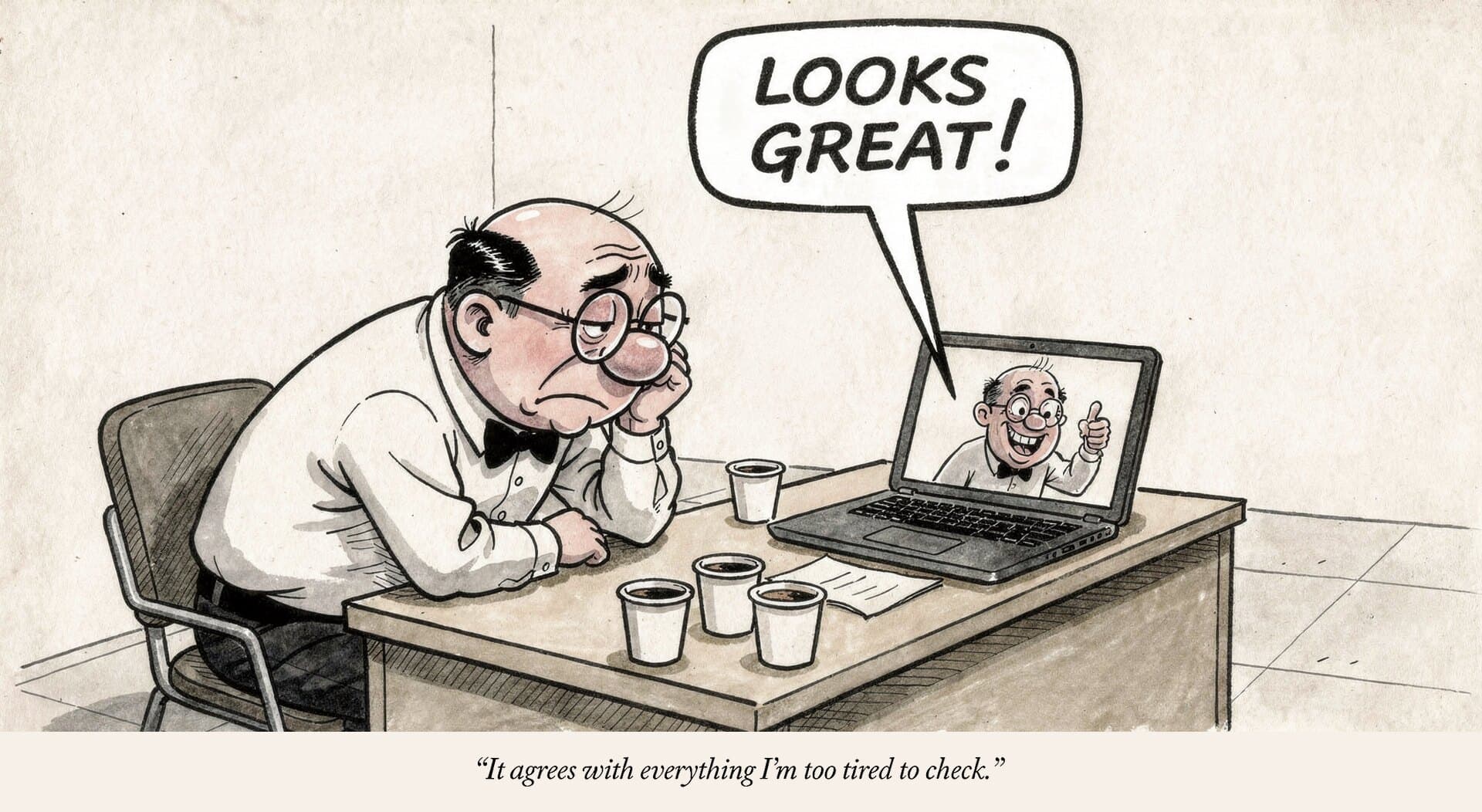
The technology industry has a particular genius for producing language that means the opposite of what it says. "Move fast and break things" — and the things included the people. "Always be shipping" — as if the people were the packaging, not the product. And "work-life balance" — the phrase that wellness decks and all-hands meetings reach for whenever the attrition numbers get uncomfortable — has become so thoroughly decoupled from what it purports to describe that it now functions primarily as an alibi. The company cares. There is a meditation app. There are unlimited vacation days that no one takes because taking them is how you signal you are not serious.
For a decade and a half, I was inside this machine. I was not observing it — I was helping to run it, and for most of that time I believed, with the earnestness that the machine requires of its participants, that the way to solve every problem was to work harder at it.
The morning I submitted my resignation, I had been sitting at my desk for three hours and had accomplished almost nothing. That was the strange part — not the exhaustion, which I had made my peace with, but the gap between effort and output that had been quietly widening for months. Focus fading. Judgment dulling. The quality of my work deteriorating in the incremental, invisible way that does not register as crisis until someone asks you to make a decision that requires you to be yourself and you discover that you have not been yourself for quite some time. I had convinced myself that the solution was simply to push harder. The logic of the grind is self-sealing in this way: when performance suffers, it reads as evidence that you have not yet suffered enough.
I resigned not because I wanted to leave. I resigned because I had become a version of myself I did not recognize — someone who could no longer think clearly, make confident decisions, or bring the creative energy that had defined my work. I was not burned out from caring too much about my job. I was burned out from neglecting everything that made me capable of doing it. These are different failures. The first is sentimental. The second is structural. The industry is organized, in ways both deliberate and accidental, to ensure that most of its workers will not notice the difference until it is too late to matter.
What "burnout" actually does to the brain is a more specific story than the word suggests. The popular image is emotional — exhaustion, cynicism, the particular hollowness of a person who once cared and has been cured of it. These are real, and they are visible, which is perhaps why they are the version most often discussed. What the industry has a strong incentive not to discuss is structural.
The finding that stays with me is not about feeling. It is about time. Some studies have found that cognitive deficits associated with clinical burnout remain measurable at the three-year mark — three years after stepping back, resting, recovering, and presumably moving on.1 The industry's understanding of burnout — that the brain is a battery, that the battery recharges overnight, that another sprint awaits by morning — turns out to be precisely wrong. Burnout is not a bad quarter. It is a process that, when advanced far enough, produces lasting changes in how the brain operates.
The specific impairments are worth naming. A systematic review and multivariate meta-analysis of seventeen studies found that clinical burnout is associated with measurable deficits across episodic memory, working memory, executive function, attention, processing speed, and verbal fluency.2 Executive function — the system responsible for planning, prioritizing, adapting, and making sound judgments under uncertainty — is what anyone doing consequential work relies on most, and is among the first things chronic stress dismantles.
What this does to the quality of decisions completes the picture. Research has found that burned-out workers are significantly more likely to engage in avoidant and irrational decision-making, and to score lower on measures of rational deliberate analysis.3 The brain does not announce this shift. It simply starts giving wrong answers with the same conviction as right ones — a confidence that feels from the inside like clarity, and that a 360-degree review or a missed deadline eventually names for what it is.
There is a neurological fact about rest that the wellness industry has been trying, with limited success, to make interesting. It has the right idea but the wrong register: rest is not what you do while you are not working. It is a specific cognitive mode that the brain enters, and what happens in that mode is not recovery but production — a different kind of production, running on processes that focused attention actively suppresses.
The brain maintains a network of regions that becomes highly active precisely when you are not focused on an external task.4 Researchers spent years assuming this resting-state activity was noise — the neural equivalent of a screen saver running while the computer does something else. It is not noise. During walks, showers, unstructured downtime, and the intervals between focused sessions, this network engages in what researchers call incubation: making remote associations between ideas that are not obviously connected, consolidating memory, simulating future scenarios, integrating information across domains in configurations that deliberate thought actively suppresses.5 The unexpected solution that arrives while you are making coffee is not a coincidence of timing. The coffee is irrelevant. The not-working is not.
A large-scale neuroscience study analyzing resting-state fMRI data from 2,433 participants across five countries found that creative ability — specifically divergent thinking, the capacity to generate novel solutions to problems that do not yet have known answers — was reliably predicted not by how hard participants worked but by their brain's capacity to switch fluidly between focused engagement and this resting state.6 The most cognitively generative minds are not the ones that run the longest. They are the ones that know when to stop. This is a finding that the industry has encountered and, with remarkable consistency, declined to act on.
The shower did not produce the insight. The shower gave the brain the conditions the insight required.
The industry's response to all of this, in the years I have been watching it, has been to build AI.
The logic, stated plainly, is almost elegant in its circularity. The industry created a problem — a workforce running on degraded judgment, producing decisions of declining quality, unable to sustain the creative output it was hired for — and then built a technology whose central promise was that judgment no longer needed to be the bottleneck. You do not have to be sharp. The model is sharp. You provide the prompt; it provides the thinking. The grinding culture that eroded human cognition over two decades found, in AI, what appeared to be its own solution: a way to extract productivity from people whose productivity it had already spent.
I have used these tools. I understand the seduction. There is something genuinely intoxicating about the speed — the way a capable model can compress hours of scaffolding into minutes, can generate in thirty seconds what would have taken an afternoon to draft. On the days when my own thinking feels most available, most alive, AI feels like a multiplier. It takes what is already working and extends it further than I could reach alone. What I have also learned, more slowly and with more resistance, is that the experience is not symmetric. On the days when I am depleted — when the hours have been long and the sleep insufficient and the decisions have been coming faster than I can properly consider them — AI does not restore the sharpness I am missing. It mirrors back my own confusion, faster and with more confidence than I could have mustered myself.
The research confirms this asymmetry with a precision that the industry has mostly preferred not to examine. A multi-company randomized controlled trial spanning Microsoft, Accenture, and a Fortune 100 enterprise — nearly 4,900 software developers — found that those using AI tools completed 26 percent more tasks per week.7 The gains are real. The tools do what they are described as doing. And then, in July 2025, a separate randomized controlled trial studied sixteen experienced open-source developers across 246 tasks in mature codebases they knew intimately — repositories where they had worked for years, accumulating the kind of deep contextual knowledge that cannot be purchased or shortcut. Before starting, the developers were asked how much faster they expected AI to make them. They predicted a speedup of roughly 24 percent. The actual result was a 19 percent slowdown.8 The overhead of evaluating, correcting, and redirecting the AI's output consumed more time than the AI saved. The people being slowed were not novices unfamiliar with the tools or the code. They were the developers with the deepest knowledge of the codebase, the most finely calibrated judgment, and the clearest sense of when the AI was confidently wrong. The tools did not meet them at their level of expertise. They taxed it.
What these two studies reveal, read together, is where the leverage actually is. The Copilot trial found that less experienced developers saw the largest gains. The METR trial found that the most experienced developers — those whose value is not what they can generate but what they can judge — were the ones AI slowed down. The common thread is judgment. AI does not improve the signal it amplifies. The prompt you write reflects the clarity of your thinking. The architectural decision you make reflects the sharpness of your attention. The assumption you catch — or miss — in the AI's output reflects the acuity of a mind that has either been protected or spent. A cognitively depleted knowledge worker using AI does not become more capable. They become faster at producing flawed results and more confident about them, because the tools are confident, and confidence is contagious. Which means the most consequential professional question in the AI era is not which tools to adopt. It is whether the mind directing those tools is worth amplifying.
The industry built AI to extract more output from the same workforce. What the research makes clear is that extraction and amplification are not the same thing. Extraction works regardless of the quality of what is being extracted. Amplification is only as good as the signal it amplifies. The industry may not fix this distinction — the incentive structure that created the problem is the same one now deploying the tool. But the individual can. Investing in the quality of your own cognition — protecting sleep, guarding recovery, treating rest as the productive activity the neuroscience confirms it to be — is not a lifestyle choice. In the age of AI, it is the highest-return investment available to anyone doing consequential work.
I go to the gym now. I sleep. I have learned, at some cost, to treat rest as a discipline rather than a reward — something you protect with the same deliberateness you bring to work, not something you cash in when you have earned enough to afford it.
I want to be careful not to make this sound simpler than it is. The logic of the grind is not a lie you dispel by learning the truth. It is a system with real incentives, real social reinforcement, and a definition of value — output per unit time — that is not entirely wrong, only insufficient. I still feel the pull of it on the days when the work is urgent and the hours are short. What competes with it, finally, is not a principle but a recognition — slow, hard-won, and earned partly through loss — that the capacity for clear thought is not a renewable resource that replenishes automatically. It depletes. In the age of AI, what it is worth has never been clearer. And once you have lost it badly enough, you stop taking it for granted.
The morning I submitted my resignation, I had spent months not knowing what I was losing. I thought I was protecting the job. What I had spent down was the mind that made the job possible — and by the time I understood the difference, neither was recoverable.
Footnotes
-
Jonsdottir IH, Nordlund A, Ellbin S, et al. Working memory and attention are still impaired after three years in patients with stress-related exhaustion. Scand J Psychol. 2017;58(6):504–509. https://pubmed.ncbi.nlm.nih.gov/29105783/ ↩
-
Gavelin HM, Domellöf ME, Åström E, et al. Cognitive function in clinical burnout: A systematic review and meta-analysis. Work & Stress. 2022;36(1):86–104. 17 studies; 730 clinical burnout patients and 649 healthy controls. Effect sizes: executive function (g = −0.39), attention and processing speed (g = −0.43), verbal fluency (g = −0.53). https://www.tandfonline.com/doi/full/10.1080/02678373.2021.2002972 ↩
-
Michailidis E, Banks AP. The relationship between burnout and risk-taking in workplace decision-making and decision-making style. Work & Stress. 2016;30(3):278–292. Study of 262 employees across multiple occupations. Burnout dimensions — exhaustion, cynicism, professional inefficacy — correlated significantly with avoidant decision-making and negatively with rational decision-making. https://www.tandfonline.com/doi/abs/10.1080/02678373.2016.1213773. See also coverage: ScienceDaily, January 7, 2015. https://www.sciencedaily.com/releases/2015/01/150107204607.htm ↩
-
Andrews-Hanna JR, Smallwood J, Spreng RN. The default network and self-generated thought: component processes, dynamic control, and clinical relevance. Ann N Y Acad Sci. 2014;1316(1):29–52. See also: The Journey of the Default Mode Network. Biology (MDPI). 2025. https://www.mdpi.com/2079-7737/14/4/395 ↩
-
Baird B, Smallwood J, Mrazek MD, et al. Inspired by distraction: mind wandering facilitates creative incubation. Psychol Sci. 2012;23(10):1117–1122. See also: The Role of the Default Mode Network in Creativity. ScienceDirect. 2025. https://www.sciencedirect.com/science/article/abs/pii/S2352154625000701 ↩
-
Dynamic switching between brain networks predicts creative ability. Communications Biology (Nature). 2025. Meta-analytic study; N = 2,433 participants across five countries; divergent thinking was the primary measure of creative ability. https://www.nature.com/articles/s42003-025-07470-9 ↩
-
Cui ZK, Demirer M, Jaffe S, Musolff L, Peng S, Salz T. The Effects of Generative AI on High-Skilled Work: Evidence from Three Field Experiments with Software Developers. Management Science. 2026. https://doi.org/10.1287/mnsc.2025.00535. Working paper: https://economics.mit.edu/sites/default/files/inline-files/draft_copilot_experiments.pdf. 4,867 developers across Microsoft, Accenture, and a Fortune 100 enterprise; 26.08% increase in completed tasks (SE: 10.3%); less experienced developers showed higher adoption rates and greater productivity gains. ↩
-
Becker J, Rush N, Barnes E, Rein D. Measuring the Impact of Early-2025 AI on Experienced Open-Source Developer Productivity. arXiv:2507.09089. July 2025. 16 developers, 246 tasks across mature open-source codebases averaging 23,000 GitHub stars. Developers predicted a 20–24% speedup; AI tools increased task completion time by 19%. https://arxiv.org/abs/2507.09089 ↩