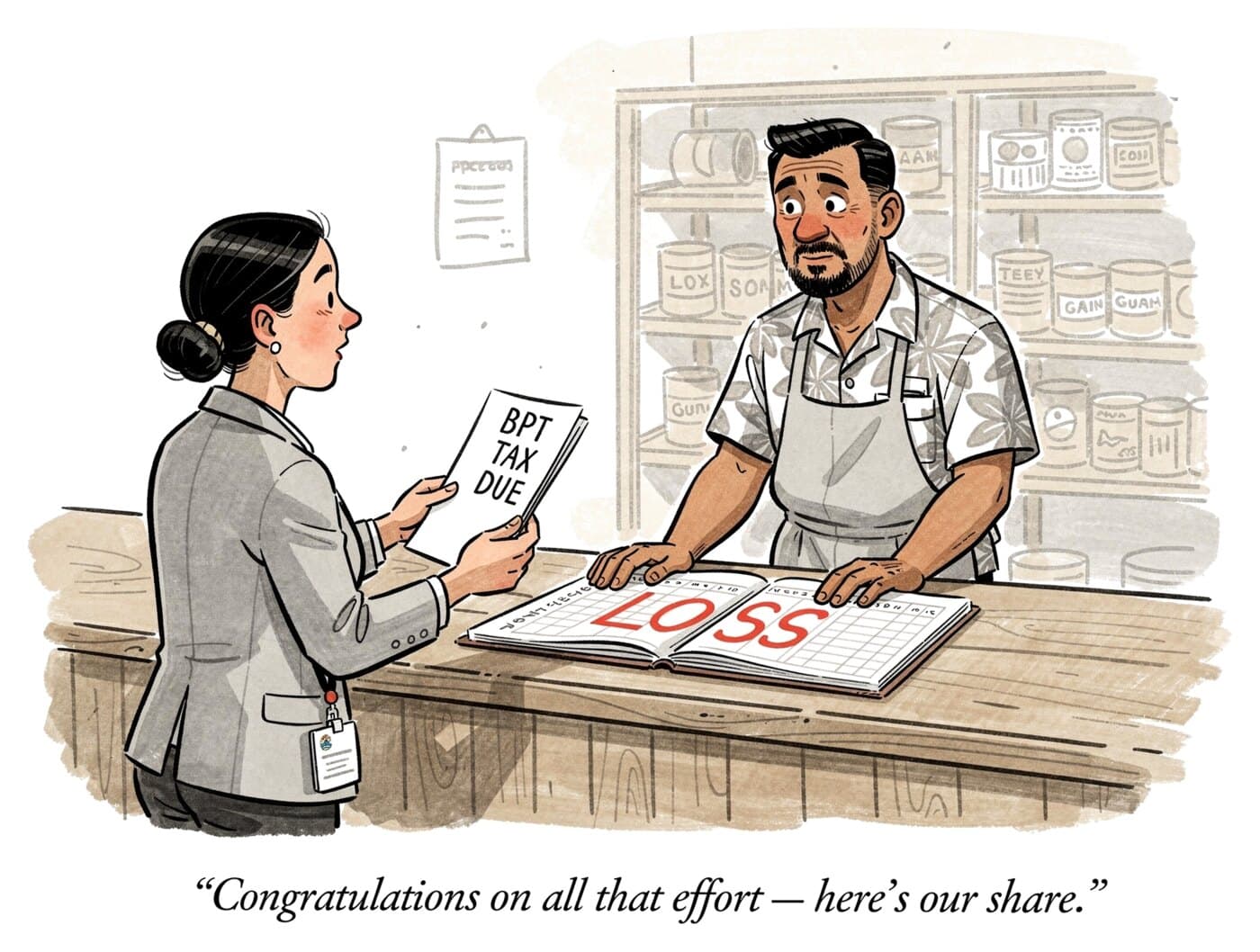
I have started businesses on two continents. I know what a government that wants you to succeed looks like — and I know what one that merely tolerates you looks like.
On Guam, building something new means navigating a licensing maze that can stretch across weeks, multiple agencies, and physical trips that no entrepreneur with a full schedule can easily spare. And even before you turn a profit — before you have paid salaries, settled rent, or covered a single utility bill — the island's tax structure has already reached into your revenue and taken its share.
That is not a complaint. It is a structural diagnosis. And structural problems have structural solutions.
This piece examines the two biggest policy walls standing between Guam and a thriving entrepreneurial economy: a registration and licensing process that has not kept pace with the digital era, and a revenue-based Business Privilege Tax (BPT) that penalizes effort regardless of outcome. I will compare both against Singapore's deliberately designed startup framework, walk through the actual numbers that explain why the difference matters, and propose the specific reforms that could change the trajectory. The frustration of the local entrepreneur is a signal worth taking seriously — because behind every founder who gives up, Guam loses a job, a service, and a piece of its economic future.
Wall 1: The Registration Maze
Starting a business on Guam should not feel like solving a puzzle designed to eliminate anyone without legal counsel and unlimited free time. Yet the process of establishing a legitimate business entity on the island continues to require navigation of multiple government agencies — the Department of Revenue and Taxation (DRT), the Guam Fire Department, the Department of Public Health and Social Services, and others — often with redundant paperwork, unclear timelines, and in-person visits that have no obvious reason to be in-person1.
There is no integrated portal where a founder can check business name availability, submit registration documents, and track licensing progress in a single session. There is no guaranteed turnaround window. There is no public-facing status tracker. There is just the wait — and the mounting uncertainty about whether the silence means approval is coming or that something has gone wrong that nobody has told you about.
Compare this to Singapore, where the Accounting and Corporate Regulatory Authority (ACRA) operates BizFile — its fully digital national business registration platform, launched in 2004 and substantially rebuilt in December 20242. Through BizFile, a founder can check name availability, submit incorporation documents, and receive a Certificate of Incorporation and a Unique Entity Number typically within one to three business days for standard applications. The entire submission can be completed in fifteen to thirty minutes if documentation is prepared3. No in-person visits. No guesswork. No agency ping-pong.
To be fair, Guam's DRT did take a meaningful step forward in 2021 when it mandated electronic filing for monthly BPT returns4. That shift matters. But mandatory electronic filing of a recurring tax return is not the same as having a digital pathway for the most consequential interaction a new business has with government: getting legally established in the first place. The gap between where Guam is and where it needs to be remains significant.
The cost of friction is not just wasted time. Every week of delay before a business can legally operate is a week of revenue lost. For a startup bootstrapped on personal savings, that kind of friction can be the difference between launching and quietly walking away.
Wall 2: The Business Privilege Tax — A Tax on Revenue, Not Profit
If the registration process is the first wall, the Business Privilege Tax is the one most likely to keep a founder up at night — not because the rate is extraordinary, but because of what it taxes.
The BPT is a gross receipts tax. It is levied on total revenue — before the business pays a single dollar in rent, wages, inventory, or utilities5. As of October 1, 2025, the general BPT rate stands at 4.5% after the Republican-led 38th Guam Legislature overrode Governor Lou Leon Guerrero's veto in August 20256. The rate is scheduled to drop further to 4% effective October 1, 2026. Most small businesses — defined by the Dave Santos Act — currently pay a reduced rate of 3%, with businesses earning under $50,000 annually fully exempt7.
These reductions are meaningful, and the legislative debate reflects genuine concern about the burden on local business. But a rate reduction does not change the fundamental architecture of the tax. Whether the rate is 5%, 4.5%, or 4%, the mechanism remains the same: you owe the government a percentage of what you earn, regardless of whether you are profitable.
That design creates a problem that no rate adjustment fully resolves.
Singapore's approach is structurally different. Singapore taxes chargeable income — net profit after legitimate business expenses — at a flat rate of 17%8. For new companies in their first three years of operation, Singapore's Startup Tax Exemption (SUTE) reduces this further: 75% of the first S$100,000 of profit is tax-exempt, and 50% of the next S$100,000 is tax-exempt, for a maximum annual exemption of S$125,0009. A qualifying startup in Singapore pays tax only on a fraction of its early profits — precisely when it needs every dollar to reinvest.
The philosophical gap is stark: Singapore taxes success. Guam, structurally, taxes effort.
The Numbers: What the Difference Looks Like in Practice
Abstract policy arguments are easy to dismiss. Concrete numbers are harder to ignore.
Scenario 1: A Business in Its First Profitable Year
Assume your business earns $300,000 in revenue with $200,000 in expenses, producing a $100,000 net profit.
| Jurisdiction | Tax Structure | Key Rates | Estimated Tax Liability |
|---|---|---|---|
| Guam | BPT on Revenue + Federal Corporate Income Tax | BPT: 4.5% on revenue; Federal CIT: 21% on net profit (less BPT) | ~$31,000 |
| Massachusetts | State Corporate Excise + Federal CIT | State: 8.0% on net income + $456 minimum; Federal: 21% | ~$29,456 |
| Singapore (SUTE, Year 1–3) | Corporate Income Tax on net profit only | 17% CIT; 75% exempt on first S$100K; effective tax on S$100K ≈ S$4,250 | ~$3,148 USD |
| Singapore (Established, PTE) | Corporate Income Tax on net profit only | 17% CIT; partial exemption on first S$200K; tax ≈ S$8,075 | ~$5,981 USD |
(Singapore USD conversion assumes 1 USD ≈ 1.35 SGD)
Reading this table: A Guam business in its first profitable year faces roughly ten times the tax liability of a Singapore startup. Even against an established Singapore company with no startup exemption, Guam's combined burden is more than five times higher. Massachusetts, representing a typical U.S. state, sits in a comparable range to Guam — reinforcing that the BPT layer is a Guam-specific burden stacked on top of an already existing federal obligation.
Scenario 2: A Loss-Making First Year
This is where the BPT's structural flaw becomes impossible to rationalize. Assume your business earns $500,000 in revenue but incurs $510,000 in costs — a loss of $10,000. Not unusual in a startup's early stages.
| Jurisdiction | Tax Structure | Tax Due on a $10K Loss | What It Means |
|---|---|---|---|
| Guam (small business, Dave Santos Act) | Revenue-Based BPT | $15,000 | Tax is owed on sales volume regardless of profitability |
| Massachusetts | Profit-Based Corporate Excise | $456 | Income tax is $0; only the statutory minimum excise applies |
| Singapore | Profit-Based CIT | $0 | No profit, no tax. Losses can be carried forward |
(Guam BPT calculated at 3% small-business rate under the Dave Santos Act. The $10,000 operating loss can be carried forward for Guam corporate income tax purposes, but this provides no immediate cash relief against the BPT obligation.)
Let that sink in. A small business on Guam posts a $10,000 operating loss. It still receives a BPT bill for $15,000. The actual financial impact on that business is not a $10,000 loss — it is a $25,000 setback. That is the loss plus the tax. For a startup with limited runway, this is not just discouraging. It can be fatal.
This is not a problem you can solve by trimming the rate. It is a problem of design. You are taxing the wrong variable.
The Cascading Effect: Why the BPT Shapes More Than Just Tax Bills
The BPT's structural incentives extend beyond the annual tax return. When businesses know that every dollar of revenue triggers a tax obligation regardless of profitability, they make different decisions — and not always better ones.
The most visible consequence is pressure to minimize every possible cost, including non-mandatory capital expenditures. Repainting a building, upgrading equipment, or investing in staff training are all expenditures that reduce profit but provide no relief against the BPT obligation. Over time, this incentive structure subtly discourages reinvestment in physical and human capital — and the effects are visible across Guam's commercial landscape in the accumulated deferred maintenance of private sector assets.
A second, less-discussed consequence is its effect on margin-thin or high-volume businesses. A logistics company moving $5 million in goods with thin margins is not in the same position as a professional services firm earning $300,000 on minimal overhead. The BPT applies uniformly to both, regardless of the structural realities of each business model. Industries that depend on volume — retail, distribution, food service — carry a structurally heavier burden relative to their actual earnings capacity.
There is also the question of growth incentives. If your BPT exposure rises in direct proportion to revenue growth, expansion becomes a tax event. Every new contract, every new customer, every new market means a larger BPT obligation — again, before you know whether the growth is actually profitable. This creates a passive disincentive to scale that no amount of entrepreneurial enthusiasm fully overcomes.
A Path Forward: Three Concrete Proposals
Critique without direction serves no one. These proposals are not wishful thinking — they have working models in comparable jurisdictions and are technically achievable on Guam with political will.
1. A Unified Digital Business Portal
The goal is simple: a founder should be able to search business names, submit registration documents, receive confirmation, and track licensing status through a single online platform — without a single mandatory in-person visit for standard applications.
The model already exists in Singapore's BizFile, updated in December 2024 with enhanced user experience and integration across all regulatory agencies10. Guam's DRT, the Bureau of Statistics and Plans, and the relevant licensing agencies need to commit to a shared backend infrastructure and a public-facing interface. E-signatures and electronic filing for amendments, annual reports, and declarations should be standard. Status transparency — knowing where your application is and what comes next — should be a baseline expectation, not a luxury.
The technical architecture for this is not novel. What it requires is inter-agency coordination and executive leadership willing to treat digital service delivery as a policy priority rather than a long-term aspiration.
2. Structural Tax Reform: Tax Profit, Not Revenue
The long-term goal should be clear: replace the BPT with a progressive corporate income tax on net profit for qualifying small and medium businesses. This is not a new idea — it is the standard approach in every economically competitive jurisdiction in the world for a reason. It aligns tax obligation with actual financial capacity.
In the near term, the following steps are achievable within the current framework:
- Expand BPT exemptions for new businesses. Extend the Dave Santos Act framework to cover a broader definition of qualifying small businesses in their first three years of operation, modeled on Singapore's SUTE. A new business operating at a loss should not face a tax bill calculated on revenue it cannot keep.
- Raise the full-exemption threshold. The current $50,000 annual revenue threshold for full BPT exemption is too low to capture the full range of businesses genuinely in their startup phase. A threshold in the $150,000–$200,000 range would provide meaningful relief to businesses that are building but not yet stable.
- Extend Net Operating Loss (NOL) carryforward periods. Guam currently allows carryforwards, but extending the period to 20 years — as Singapore does for certain categories — would allow businesses that absorb early losses to fully offset future taxable income, providing real relief when growth finally arrives.
It is worth noting that the October 2025 BPT reduction was flagged as credit negative by Moody's, which projected an approximately $80 million reduction in annual government revenue at a time when Guam Memorial Hospital is posting operating losses approaching $65 million per year11. The fiscal trade-offs are real. A transition to profit-based taxation must be accompanied by a credible revenue recovery plan — whether through broadening the tax base, targeted federal partnerships, or phased implementation. Tax reform that destabilizes the government's ability to fund hospitals and schools helps no one. The goal is a more equitable and growth-oriented structure, not a smaller government funded by less.
3. Government as Co-Investor: The GEDA Startup Fund
The Guam Economic Development Authority (GEDA) has historically focused its incentive programs on large qualifying certificates for capital-intensive businesses. That focus has value, but it leaves an entire tier of the economy — early-stage, founder-led ventures in technology, agriculture, services, and export-oriented sectors — without institutional support.
A dedicated GEDA co-investment fund, modeled on Singapore's Startup SG framework, could change this. The mechanics are straightforward: the fund co-invests alongside verified local angel investors in qualifying companies, reducing individual investor risk and creating a catalytic signal to the broader market that Guam takes its startup ecosystem seriously. Paired with Innovation Zone designations — geographic areas offering accelerated permitting and temporary tax relief for qualifying early-stage businesses — this could create pockets of genuine entrepreneurial momentum on the island.
This is not charity to founders. It is infrastructure investment in the sector most likely to produce the economic diversification Guam urgently needs.
The Signal Worth Heeding
Every founder who gives up because the numbers don't work is not just a personal loss. It is a data point in a pattern that, taken in aggregate, tells us something important about how the island's policy structure regards its own economic future.
Guam has genuine advantages: a location that bridges time zones between Asia and the United States, a U.S. legal and currency framework, a growing military presence driving infrastructure investment, and a community with genuine entrepreneurial instinct. These advantages are real. But advantages only translate into outcomes when the systems around them are designed to amplify rather than suppress the energy of people willing to build something.
The entrepreneurs on this island are not asking for a handout. They are asking to keep more of what they earn before they earn it — and to not be taxed on losses they cannot afford. That is a reasonable ask. It is also, if we take it seriously, the beginning of a very different economic story for Guam.
We are called to be good stewards of what we have been given — and an island with Guam's strategic position, its people, and its aspirations is a remarkable gift. Squandering that potential through policies that exhaust founders before they reach the starting line is not caution. It is waste. The infrastructure for a thriving entrepreneurial economy is within reach. What it requires now is the will to build it.
Footnotes
-
The business licensing process on Guam requires interaction with multiple agencies, including the Department of Revenue and Taxation (DRT), Guam Fire Department, and the Department of Public Health and Social Services depending on business type, without a unified digital portal for the full registration process. Source: Guam DRT. https://www.guamtax.com/ ↩
-
Singapore's ACRA BizFile portal was launched in 2004 and underwent a significant redesign in December 2024, enhancing user experience and integration across regulatory agencies. Source: ACRA Singapore. https://www.acra.gov.sg/; InCorp Global: https://www.incorp.asia/blogs/acra-bizfile/ ↩
-
Singapore company incorporation through BizFile typically completes within one to three business days for standard applications, with the submission process itself taking 15–30 minutes when all information is prepared. Complex applications referred to other agencies may take longer. Source: Swiftly SG. https://swiftly.sg/blog/complete-guide-to-acra-in-singapore; Chambers and Partners Doing Business Guide 2025. https://practiceguides.chambers.com/practice-guides/doing-business-in-2025/singapore ↩
-
Guam mandated electronic filing of Business Privilege Tax returns beginning with the February 2021 filing period, pursuant to P.L.35-199. Source: Guam DRT Public Notice, March 2021. https://www.guamtax.com/notices/notices.html ↩
-
The Guam Business Privilege Tax is a gross receipts tax levied on total revenue before deduction of any business expenses, defined under Title 11, Division 2, Chapter 26 of the Guam Code Annotated. Source: Guam Code Title 11 Chapter 26. https://law.justia.com/codes/guam/title-11/division-2/chapter-26/ ↩
-
The 38th Guam Legislature overrode Governor Lou Leon Guerrero's veto in August 2025, passing the FY2026 budget bill (S-Bill 44) which reduced the BPT from 5% to 4.5% effective October 1, 2025, with a further reduction to 4% scheduled for October 1, 2026. The bill passed 11–4 along largely partisan lines. Source: Pacific Island Times. https://www.pacificislandtimes.com/post/guam-legislature-oks-2026-budget ↩
-
Under the Dave Santos Act, most small businesses on Guam qualify for a reduced BPT rate of 3%. Businesses with annual revenues below $50,000 receive a full BPT exemption. Source: Governor of Guam Press Release, January 30, 2025. https://governor.guam.gov/press_release/governors-statement-on-bpt-reduction-in-bpt-does-not-reduce-prices/ ↩
-
Singapore's corporate income tax is levied at a flat rate of 17% on chargeable income (net profit after deductible expenses). This rate applies to both local and foreign companies. Source: Inland Revenue Authority of Singapore (IRAS). https://www.iras.gov.sg/taxes/corporate-income-tax/basics-of-corporate-income-tax/corporate-income-tax-rate-rebates-and-tax-exemption-schemes; Singapore Ministry of Finance. https://www.mof.gov.sg/policies/taxes/corporate-income-tax/ ↩
-
Singapore's Startup Tax Exemption (SUTE) provides qualifying newly incorporated companies a 75% tax exemption on the first S$100,000 of chargeable income, and a 50% exemption on the next S$100,000 of chargeable income, for each of their first three consecutive Years of Assessment (YAs). The maximum annual exemption is S$125,000. The scheme applies to companies incorporated in Singapore with at least one individual shareholder holding a minimum of 10% of ordinary shares. Source: IRAS. https://www.iras.gov.sg/taxes/corporate-income-tax/basics-of-corporate-income-tax/corporate-income-tax-rate-rebates-and-tax-exemption-schemes ↩
-
ACRA launched the redesigned BizFile portal in December 2024, replacing the previous BizFile+ system, with improvements to user experience and streamlined operations. As of July 2025, Singapore hosts over 614,000 active business entities. Source: InCorp Global. https://www.incorp.asia/blogs/acra-bizfile/ ↩
-
Moody's rating agency described the October 2025 BPT reduction as "credit negative" for Guam, projecting approximately US$80 million in annual revenue loss at a time when Guam Memorial Hospital continues to post operating losses approaching US$65 million per year. The agency's comments were characterized as a warning signal potentially preceding a formal credit downgrade. Source: Island Times, October 7, 2025. https://islandtimes.org/guams-tax-cut-is-a-credit-negative-rating-agency-says/ ↩