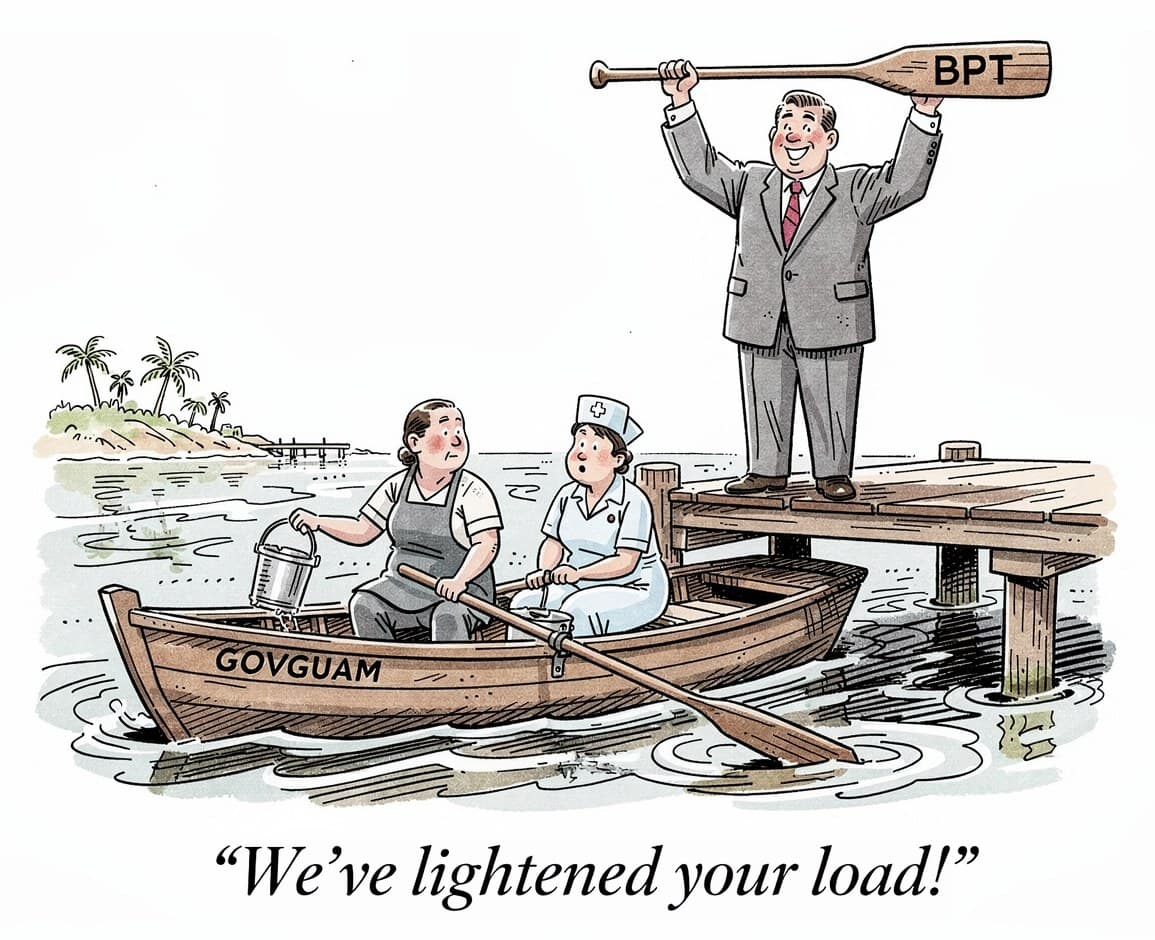
I keep thinking about two women. One runs a small grocery and unlocks her doors before the heat settles in. The other is a nurse at Guam Memorial Hospital, finishing a night shift in a building that has struggled for years to pay its bills. Neither is a real person, exactly; each is a composite of people anyone on the island passes every day. On the first of October, both had a stake in the same number. Guam's business privilege tax fell to 4 percent, where it stood before lawmakers raised it in 2018.1
The number arrived by a contested path. The amendment setting the 4 percent date passed with eight votes, a majority of one.2 The Governor vetoed the budget that carried it, warning of potentially dangerous shortfalls while the hospital was struggling to pay its vendors,3 and lawmakers overrode her, eleven to four.4 This summer, a budget that kept the cut passed thirteen to two, and the Governor let it become law.5
Last year, in an essay called "Taxing Effort," I argued that the privilege tax charges businesses on their revenue rather than their profit, so that a founder can lose money and still owe thousands.6 I still believe that. But watching this year's debate, I came to think that the essay told only half the story. The grocer is right that the tax is badly designed. The nurse is right that the money has to come from somewhere. A wiser path would honor them both.
It is worth remembering what taxes are for. They buy what none of us can buy alone: the hospital bed at two in the morning, the classroom, the paved road, help for a neighbor who has fallen. A landmark review of tax design, chaired by the Nobel laureate James Mirrlees, began from the same premise: a tax system must raise what public needs require.7
That premise rules out the easy answers on both sides. Cutting a tax without a plan to replace the revenue does not make the need disappear; it moves the burden somewhere else. The privilege tax went to 5 percent in the first place to make up for revenue the island lost to federal tax cuts, and the increase was meant to be temporary.8 It lasted until last year.
Yet the rollback's supporters have a fair point of their own. When the rate first dropped to 4.5 percent, the Guam Chamber of Commerce pointed to first-quarter collections that beat projections by $27.7 million and called for a leaner, more efficient government.9 Some lawmakers now say they will require agencies to tie budgets to measurable results.10 It is common ground worth building on.
Making each dollar stretch further sounds like a slogan, but it is closer to arithmetic. The International Monetary Fund studied public investment in 134 countries and found that about 30 percent of its potential value is lost to inefficiency. The most efficient governments get twice the economic return of the least efficient.11 For the nurse, that lost third is not an abstraction. It is the renovation that costs more than it should, the equipment that waits another year.
Guam's own auditors say there is room to improve. The government's audit for fiscal 2024 arrived nine months after its legal deadline, with 53 findings, and the auditors described a four-year trend of longer delays, more findings, and consistently high questioned costs.12 A public that cannot see clearly where its money goes will always suspect that more of it is wasted than is. Timely audits are not a bureaucratic nicety. They are the price of trust, and trust is what makes taxes bearable.
They are also a precondition. A government that cannot yet account for its money on time must earn the public's confidence before it invests that money for the future.
Singapore is often held up as proof that low taxes and a generous state can coexist, though rarely with an explanation of how. Its government may spend up to half of the expected long-term real returns on its national reserves, and those returns now fund about a fifth of its budget.13 Singapore's low taxes were saved for, a generation at a time.
Alaska offers a closer example. In 1976, Alaskans amended their constitution to save part of their oil wealth and to protect the principal from being spent.14 The first deposit, in 1977, was $734,000.14 Today the fund's annual draw, capped by law at 5 percent of its average value, provides more than half of the state's unrestricted general fund revenue.15
Guam has no oil. A fair skeptic will also ask why an island still carrying debt should save at all. The government's net position remains negative, and its recent improvement owes something to replacing current obligations with long-term bonds.12 The answer is sequence. A fund comes after the books balance and the audits arrive on time, not before, and its principal must be protected by law from the temptation to spend it.
A first step has already been taken. This year's budget directs unobligated surplus collections from fiscal 2026 into the Rainy Day Fund.16 If such savings were placed in a permanent fund, invested independently, with only half of the earnings available to supplement the budget, the island would have planted something its grandchildren could stand under. Such a fund would supply a few million dollars a year against a billion-dollar budget. Alaska's fund grew because oil royalties fed it every year; Guam's would need a steady stream of its own. Every dollar that fund earns is a dollar that does not have to be taken from a shopkeeper's register.
With dollars stretching further and savings beginning to earn, Guam could afford to change what it taxes, gradually enough that no one is hurt along the way. A tax on profit carries a mercy within it: a business that has not yet earned anything owes nothing, and pays more only as it grows. In a bad year, the grocer would owe nothing at all; in a good one, she would pay her share from money she actually had. Help a business grow until it can afford to pay, and it will pay for decades.
Palau, Guam's neighbor to the southwest, shows that such a change can be made, and how carefully it must be done. In 2023, it replaced its gross revenue tax with a 10 percent goods-and-services tax and a 12 percent tax on business profits.17 Prices jumped, and inflation peaked at 13 percent. Then it receded. Revenue exceeded expectations, and by the end of 2024 inflation had eased to about 2 percent. The International Monetary Fund credits the reform, together with renewed American funding under the Compact of Free Association, with significantly improving Palau's finances.18
The privilege tax's defenders are right about one thing: a tax on sales brings steadier revenue than a tax on profits, which swing with the economy.19 That is why Guam should move in stages, and why the destination pairs a profit tax with a broad tax on consumption. It could first stop taxing the same goods twice as they pass from supplier to retailer. It could then let businesses choose the system Palau adopted, a broad goods-and-services tax with credits for what they buy and a tax on profits rather than receipts, with relief for new ventures, while others keep the old system until the new one proves itself. Only after the hospital's share is guaranteed and families are protected from price shocks should the change be completed. This Legislature could begin with three decisions: setting aside a fixed share of each year's surplus in a protected fund, requiring a public revenue model for the transition, and letting businesses credit the privilege tax already paid to Guam suppliers. Done in reverse, reform would repeat the old mistake of tax cuts that promised to pay for themselves.
Many of us learned as children the story of the servant who was entrusted with his master's money and buried it out of fear, and of another who put it to work and returned it multiplied. The story was never about money. It was about what we do with what has been placed in our hands. Public money is one of those things, and so is the energy of people willing to start something new.
Somewhere tonight, the grocer is counting her drawer, and the nurse is starting another shift. A good tax system would serve them both. It would fund the hospital fully, waste as little as possible, let the island's savings carry part of the load, and ask nothing of a new business until it has something to give. The places people choose to live and build in are rarely the ones with the lowest tax this year; they are the ones whose rules a family or a founder can still trust ten years from now. None of that requires a miracle. It requires the long view, and the willingness to begin.
Footnotes
-
11 GCA Chapter 26, Business Privilege Tax Law, § 26202 and compiler's notes citing P.L. 34-087 and P.L. 34-116 (2018). https://law.justia.com/codes/guam/title-11/division-2/chapter-26/ ↩
-
"Guam senators narrowly pass amendment to cut business privilege tax," Pacific Island Times. https://www.pacificislandtimes.com/post/guam-senators-narrowly-pass-amendment-to-cut-business-privilege-tax ↩
-
Mar-Vic Cagurangan, "Guam governor vetoes 2026 budget bill, hopes to sway Republicans to reconsider business privilege tax cut," Pacific Island Times. https://www.pacificislandtimes.com/post/guam-governor-vetoes-2026-budget-bill ; "$40M GMH funding bill passed," The Guam Daily Post. https://www.postguam.com/news/local/40m-gmh-funding-bill-passed/article_5c229a4b-0357-4a6c-b86f-21e7865a1d81.html ↩
-
"Senators override governor's veto of Guam's 2026 budget bill," Pacific Island Times. https://www.pacificislandtimes.com/post/senators-override-governor-s-veto-of-2026-budget-bill ↩
-
"Guam legislature passes revised budget, but nixes governor's policy changes," Pacific Island Times. https://www.pacificislandtimes.com/post/guam-legislature-passes-revised-budget-but-nixes-governor-s-policy-changes ; National Association of State Budget Officers, "Guam: Enacted Budget – Fiscal Year 2027." https://www.nasbo.org/mainsite/resources/proposed-enacted-budgets/guam-budget ↩
-
Samuel S. Kim, "Taxing Effort," SK102 Insights, October 26, 2025. https://sk102.co/insights/taxing-effort ↩
-
Institute for Fiscal Studies, Tax by Design: The Mirrlees Review (Oxford University Press, 2011). https://ifs.org.uk/books/tax-design ; summary of principles: https://ifs.org.uk/mirrlees-review ↩
-
John O'Connor, "Senators debate BPT reduction," The Guam Daily Post, August 13, 2026. https://www.postguam.com/news/local/senators-debate-bpt-reduction/article_ca486a74-7b48-4a62-b217-691fff0fcd9c.html ↩
-
"Chamber on BPT rollback impact: 'Sky is not falling,'" The Guam Daily Post. https://www.postguam.com/business/local/chamber-on-bpt-rollback-impact-sky-is-not-falling/article_229f16b9-9a07-47e9-85cd-0ff3537573bb.html ↩
-
"Finance chair balks at governor's call to keep BPT at 4.5% in FY27," The Guam Daily Post. https://www.postguam.com/news/local/finance-chair-balks-at-governors-call-to-keep-bpt-at-4-5-in-fy27/article_885ce815-2309-48ae-af59-4275e40d8efa.html ↩
-
"IMF Survey: Closing Efficiency Gaps Means Big Gains for Public Investment," International Monetary Fund, June 18, 2015. https://www.imf.org/en/News/Articles/2015/09/28/04/53/sonew061815a ; full study: https://www.imf.org/external/np/pp/eng/2015/061115.pdf ↩
-
"Audit cites delays, compliance issues, surplus in general fund," The Guam Daily Post. https://www.postguam.com/news/local/audit-cites-delays-compliance-issues-surplus-in-general-fund/article_001e3d98-d703-43d5-8e98-30277a0e094f.html ↩ ↩2
-
Singapore Ministry of Finance, "What are the reserves used for?" https://www.mof.gov.sg/policies/reserves/what-are-the-reserves-used-for/ ↩
-
Alaska Permanent Fund Corporation, "Our History." https://apfc.org/history/ ↩ ↩2
-
Alaska Permanent Fund Corporation, "Fund Structure." https://apfc.org/the-fund/fund-structure/ ↩
-
"Guam legislature passes $1.42B FY2027 budget bill with 4% BPT rollback," Marianas Business Journal. https://www.mbjguam.com/guam-legislature-passes-142b-fy2027-budget-bill-4-bpt-rollback ; National Association of State Budget Officers, "Guam: Enacted Budget – Fiscal Year 2027." https://www.nasbo.org/mainsite/resources/proposed-enacted-budgets/guam-budget ↩
-
Republic of Palau, Ministry of Finance, "Tax Reform." https://www.palaugov.pw/taxreform/ ↩
-
International Monetary Fund, Republic of Palau: 2025 Article IV Consultation, including Annex I, "Tax Reform in Palau: A Key Milestone." https://www.elibrary.imf.org/view/journals/002/2026/022/article-A001-en.xml ↩
-
"Resisting the Allure of Gross Receipts Taxes: An Assessment of Their Costs and Consequences," Tax Foundation. https://taxfoundation.org/research/all/federal/gross-receipts-tax/ ↩