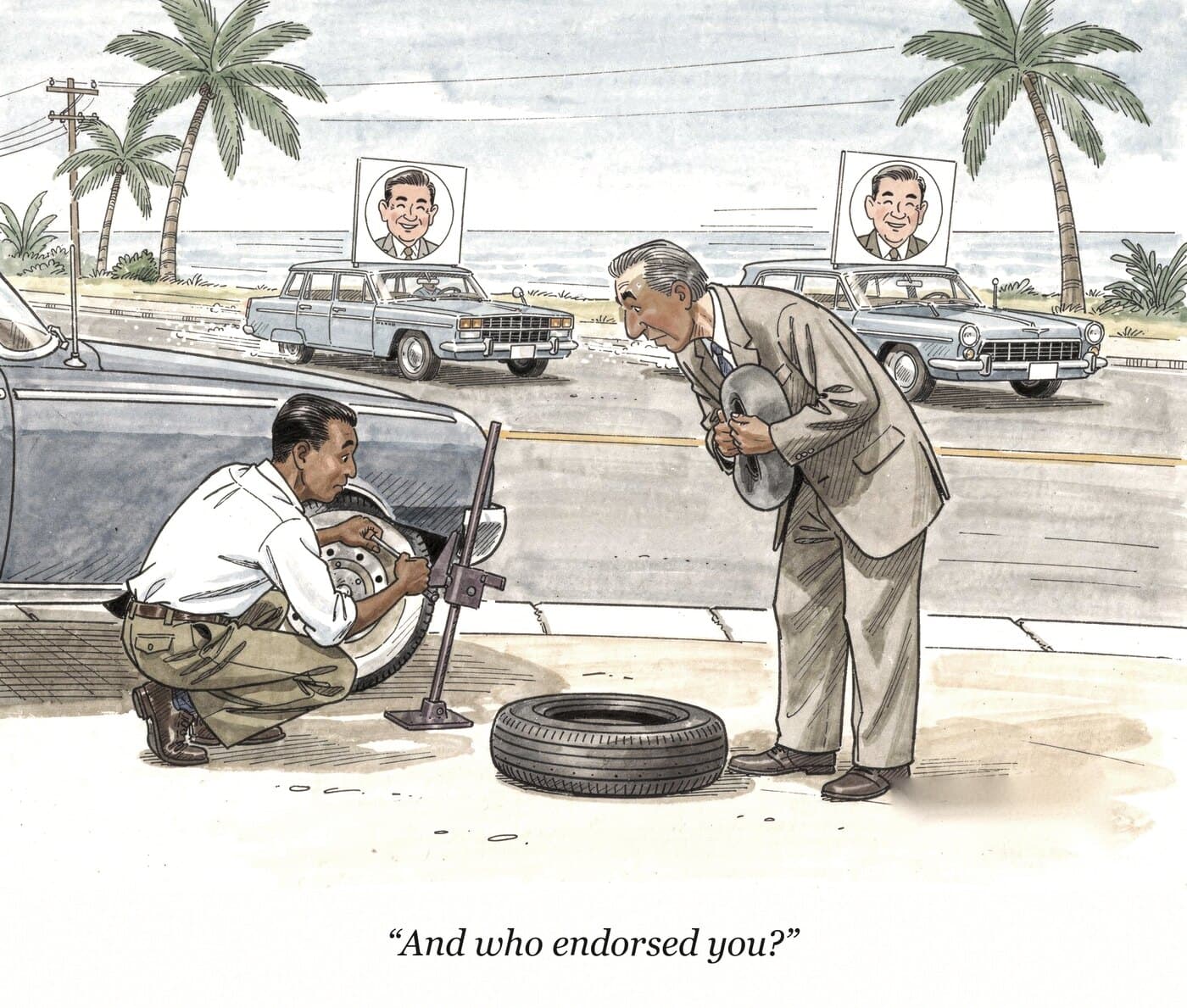
By late October, the faces are everywhere. They smile at you from plywood along the roadside, from the tailgates of pickups, from your phone while you wait in line for coffee. Under a lot of them runs a second, smaller line of names: the senator who signed on, the mayor who gave a blessing, the family whose last name still opens doors. On an island this size, those names matter. The campaigns know it, and they spend months chasing them.
On Tuesday, November 3rd, Guam picks a governor, an attorney general, a delegate to Congress, and the members of its Legislature.1 I haven't lived here long enough to claim this island's memory, and I'm not going to tell anyone how to vote. But I'd like to say one thing, neighbor to neighbor, that may not be popular: of everything on that sign, the endorsements matter least.
That's not quite fair, and I know it. An endorsement is a shortcut, and most of us need shortcuts. We work. We raise kids. We drive our parents to their appointments. Who has the evenings to sit through every forum? When someone we trust vouches for a candidate, they're lending us their judgment, and there's nothing foolish about borrowing a wise person's judgment. Experience counts, too. Someone who has spent years inside government knows where the levers are, how a budget really moves, who returns calls. A newcomer with a good heart and no map can wander a long time before finding the right door.
I take those arguments seriously. But an endorsement can only tell you who a candidate knows. It can't tell you who that candidate will serve on the day what the endorsers want and what the public needs stop lining up. Experience is the same way. It's a tool, and it's only as good as the hand holding it. The career isn't the problem. The problem is the quiet belief, which politics seems to grow everywhere, that a career is owed its next step.
I think voters feel this, and on Guam they've been saying so by staying home. In the 2024 general election, 30,283 of 62,098 registered voters cast a ballot. That's about forty-nine per cent. The executive director of the Guam Election Commission didn't dress it up: "It's the worst so far."2 In 1994 and 1998, eighty-five per cent turned out.3 Primaries always draw fewer people, but this August's still brought out fewer than four in ten.4
People skip elections for all kinds of reasons, and I don't know most of them. But I'd guess one is plain tiredness, a sense that the names keep changing and nothing else does.
So what do voters want? When you listen, it's rarely a famous name. In July of 2024, outside an early-voting site, a Santa Rita man named Bill Duenas told KUAM that "a clean government is all I ask, nothing else."5 At this year's primary, a couple who'd come to vote together told the Guam Daily Post how few people bother to turn out, and how many complain afterward. Their answer to the complainers: "Well, did you vote?"6
Someone honest. Someone who shows up. That isn't a lot to ask. It's what we expect from a parent, or a good foreman, or a pastor. Somehow it's the hardest thing to find on a campaign sign.
Two thousand years ago, Jesus told a story about a man beaten by robbers and left half-dead by the road. The first two to come along were a priest and a Levite, men of standing whose names would have looked fine on any endorsement list. Both crossed to the other side. The one who stopped was a Samaritan, from a people the listeners had been taught to distrust, with no title at all. He bandaged the man, paid for his care out of his own pocket, and promised to come back and cover whatever else it cost.7 Put it in campaign terms: the people with the right names walked past. The one with no name to lend did the work.
He told it to answer a lawyer who wanted to know who counts as a neighbor. I've always thought it answers another question as well: what does love look like when it's inconvenient, and nobody's thanking you, and it costs real money? Near the end of his life, the same teacher knelt with a basin and a towel and washed his own students' feet, then told them that this is what leading looks like.8 Whatever you believe about him, I don't know a better picture of public service.
We need that kind of service here, and soon. Last year, L.B.J. Elementary and Chief Brodie Memorial closed. This June, the Board of Education weighed closing six more schools, all in the southern villages, before voting to keep every campus open through the coming year while it gathers more data. Education officials point to falling birth rates and rising operating costs,9 and to ten years of shrinking enrollment.10 Every empty desk is a family deciding whether their kids have a future here. With numbers like that, we can't afford leaders whose first project is their own next job.
That goes double for the office charged with keeping everyone else honest, and this year the rules make that race riskier than usual. There was no primary to narrow the attorney general's field, so five candidates will split a single November vote.11 Under Guam law, whoever gets the most votes wins.12 That means the candidate most voters don't want can still end up in office, just because the votes against that candidate got divided among the others. The way around that isn't guessing who's ahead. It's deciding which candidate actually meets the test, and sticking with that choice.
The attorney general is the government's chief legal officer and also its public prosecutor,13 so sometimes the office has to hold to account the very government it represents. In that office, I'd want a lawyer who has worked inside that office as a prosecutor and has also stood beside the accused as defense counsel, someone who knows what the law owes to both. I'd want someone who cared about how public money gets spent and how contracts get awarded long before a campaign made it a talking point. And I'd want that person loyal to the island, not to whoever might come asking for a favor later.
In the days that remain, here are a few questions worth carrying into the booth, for every race on the ballot. Where was this person before there was a race to run? Who did they help when helping got them nothing? How do they treat people who can't do anything for them: the server, the volunteer, the neighbor with the other candidate's sticker on the truck? I'd ask what they would do if the right decision cost them the next election, and I'd watch whether they answer or step around it. I'd look for promises with numbers attached, and an honest word about where the money comes from. None of this is hidden. It's in the recorded candidate forums, in the votes of those who've already held office, and in the campaign-finance reports every candidate now files with the Election Commission each quarter, which show who's paying for each campaign.14
Nobody will pass every test. We're not looking for a savior. We're looking for someone who'd do this work even if nobody ever put their face on a sheet of plywood. That person is on your ballot somewhere, I believe, waiting to be noticed.
On November 4th, the signs start coming down. The famous names under the photos go back to their own lives. What's left, for the next four years, is the person behind the sign: the one who's awake at two in the morning when the typhoon turns, or the budget won't balance, or a family in a southern village calls because nobody else will pick up. Choose the one who picks up. And please, go vote.
Footnotes
-
International Foundation for Electoral Systems, "Guam: Election for Liheslaturan Guåhan," ElectionGuide, updated August 11, 2026. https://electionguide.org/elections/id/5102/ On the attorney general's race, see note 11. ↩
-
John O'Connor, "Election complete, GEC to work on comparison report, registry purge," The Guam Daily Post, January 3, 2025. https://www.postguam.com/news/local/election-complete-gec-to-work-on-comparison-report-registry-purge/article_15d29272-c97b-11ef-b617-674061113e5f.html ↩
-
"GEC hopes for higher turnout," The Guam Daily Post, 2014. https://www.postguam.com/news/local/guam-registered-voters-at-nearly-52-000/article_f42115c7-efa7-5610-8893-97a43d2d38a8.html ↩
-
"Guam primary draws 39.81% turnout as GEC releases unofficial results, schedules Aug. 15 ballot count," The Guam Daily Post, August 2026. https://www.postguam.com/news/local/guam-primary-draws-39-81-turnout-as-gec-releases-unofficial-results-schedules-aug-15-ballot/article_b0a6c138-6f2c-474d-a742-7432f3c8d316.html ↩
-
"Over 2,600 people vote early in Guam's primary," KUAM News, July 29, 2024. https://kuam.com/story/51100351/over-2600-people-vote-early-in-guams-primary ↩
-
Shane Tenorio Healy, "'We've always voted together,'" The Guam Daily Post, August 1, 2026. https://www.postguam.com/news/local/weve-always-voted-together/article_5c2a1ef0-21f2-4c11-8b17-779dff6284f3.html ↩
-
The Gospel of Luke, 10:25–37. https://www.biblegateway.com/passage/?search=Luke+10%3A25-37&version=NIV ↩
-
The Gospel of John, 13:1–17. https://www.biblegateway.com/passage/?search=John+13%3A1-17&version=NIV ↩
-
"Board: No Guam schools will close during 2026-27 school year," Isla Public Media (KPRG), June 17, 2026. https://www.islapublic.org/news/2026-06-17/board-no-guam-schools-will-close-during-2026-27-school-year ↩
-
"Education officials consider joint use for campuses rather than closing schools," Isla Public Media (KPRG), June 24, 2026. https://www.islapublic.org/news/2026-06-24/education-officials-consider-joint-use-for-campuses-rather-than-closing-schools ↩
-
Shane Tenorio Healy, "Bar association survey shows Tydingco favorite for next AG," The Guam Daily Post, June 1, 2026. https://www.postguam.com/news/local/bar-association-survey-shows-tydingco-favorite-for-next-ag/article_c9b7886a-5098-4150-bcf6-2831f379e950.html ↩
-
5 Guam Code Ann. § 30101(b), certifying "the candidate receiving the most votes" in the General Election (Justia, 2023 compilation). https://statecodesfiles.justia.com/guam/2023/title-5/division-3/chapter-30/chapter-30.pdf ↩
-
5 Guam Code Ann. § 30109 ("The Attorney General is the public prosecutor"), and the source note to Article 1 citing P.L. 13-117:1 (1975), which designates the Attorney General "the Chief Legal Officer of the Government of Guam" (Justia, 2023 compilation). https://statecodesfiles.justia.com/guam/2023/title-5/division-3/chapter-30/chapter-30.pdf ↩
-
Public Law 38-19, establishing quarterly campaign-finance reporting to the Guam Election Commission under 3 GCA § 17116, signed June 17, 2025. https://guamlegislature.gov/38th_Guam_Legislature/Public_Laws_38th/Public%20Law%2038-19.pdf ↩