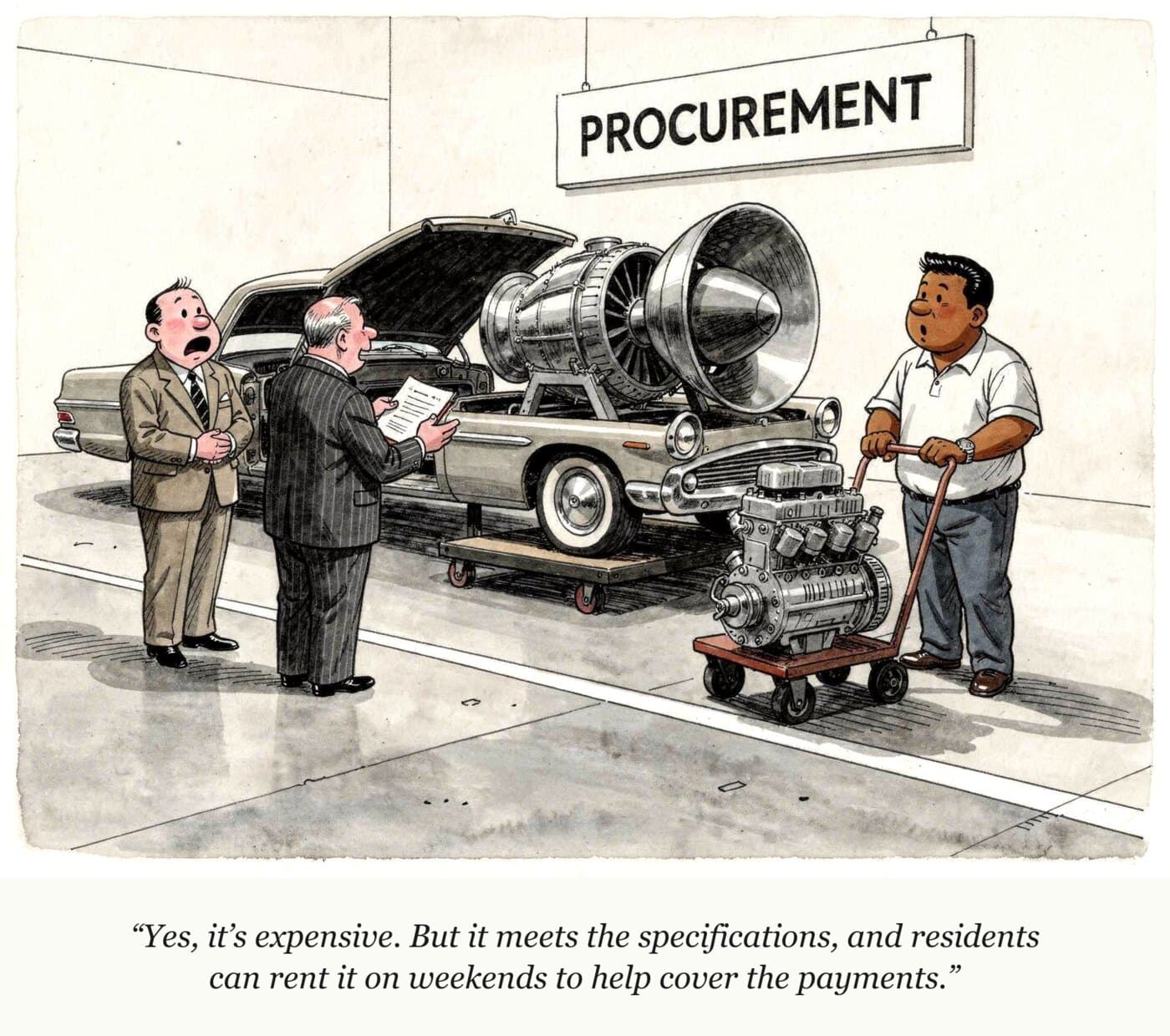
I am a private person, and given the choice, I would remain one. I began writing only because something needed saying that I wasn't hearing said. So when Ryan Mummert invited me onto his podcast, Datapoints,1 and I learned it would be filmed for YouTube, I nearly declined. But the same impatience that put a pen in my hand put me in the chair. Somewhere in the conversation, I heard myself say it: Guam's procurement process feels like a wall that needs to come down.
I am still learning this island. But I have spent my career building systems that make ordinary tasks easier, and I stayed because I believe Guam is in a rare position. It is small enough to fix its government from end to end, and it does not need a miracle to do it.
Anyone who has watched a public project here knows the rhythm: solicitation, award, protest, stay, and a wait. Under Guam law, a timely protest halts the procurement until the protest is finally resolved.2 The stay exists for a sound reason. Public money attracts private appetite, and a losing bidder deserves to be heard before a contract is signed.
The referee is not the problem. Guam's Public Auditor received nine procurement appeals in 2025 and reports resolving them generally within 90 to 120 days.3 Where the time goes is on either side of that window. The law gives agencies no fixed deadline to decide a protest, only that they do so "promptly," and a losing party can still go to court afterward.2 Above all, when every project is one enormous contract, a single protest freezes everything at once.
Residents pay for the wait in ways no budget records: the morning off work to stand in a line, the second trip because a form changed, the business that opens a year late. Time is the one tax every family pays in full.
There is a quieter cost, the one I described to Ryan. Picture a small local firm that knows how to digitize a public service for a fraction of what a large mainland integrator would charge. It can help the agency understand what to ask for, and risk being shut out of the work. Or it can stay silent and hope the solicitation happens to describe its approach. Most of us stay silent. So the island keeps buying the same kind of thing from the same kind of seller. Nobody has to act in bad faith for that to happen. The design does it on its own. I run such a firm, so read this knowing I have a stake. I would make the same argument if I didn't.
The way out begins with holding that conversation in public. Federal rules generally bar a firm that writes complete specifications from supplying the item, because the drafter can tilt the requirements toward himself. Guam asks officials to find in writing that no substantial conflict of interest exists.4 Both rules guard against private influence, not against listening, and federal rules draw the line between the two. They encourage agencies to talk with every interested company, through industry conferences, draft solicitations, and even one-on-one meetings, so long as anything specific told to one bidder is then told to all.5
Guam already practices a sliver of this: its regulations send draft specifications for common-use items out for comment before they are final.6 A pragmatic administration would extend that habit to every significant solicitation: the draft published, comments invited and posted, and every commenter still eligible to bid. Advice offered in the open is far harder to rig than advice whispered in an office, and the small firm with the better idea finally gets heard.
Once a small firm is in the room, it needs work it can actually win, which means buying smaller. Big projects are where public technology most often goes wrong. Research by the Standish Group found that only 13 percent of large government technology projects succeed.7 Washington spends more than $100 billion a year on technology. Its own auditor, the Government Accountability Office, has kept IT acquisition on its high-risk list since 2015, because projects so often fail, run over budget, or fall behind schedule.8 Reformers' prescription has been consistent: break systems into modules, keep contracts to three years or less, and fund work in increments so an agency can stop paying for what doesn't work. They also urge governments to own their code, so no single vendor holds the keys.9 Britain did something similar, opening its digital frameworks to small suppliers and splitting large contracts into smaller ones. By early 2018, small and medium-sized firms had won 48 percent of the £3.2 billion spent through those frameworks since 2012.10
Smaller contracts also blunt the protest problem: a dispute over one module pauses one module, and the rest of the work goes on. And Guam's law already asks for this kind of opening. It directs that solicitations promote local participation and forbids demanding off-island experience without written justification.11 Smaller contracts are how that promise reaches a five-person firm.
Modular buying is also the cheaper way to be wrong: a pilot costs only what one module costs, and it can be stopped before the money is gone. It does ask more of the government's own people, who must define each piece, judge the work, and fit it together. That is not a reason to avoid it. It is where the investment belongs.
Guam counted 153,836 people in the 2020 Census.12 Estonia, a larger country, now offers about 99 percent of its government services online.13 An island our size has fewer pieces to move. Change here does not have to take a generation.
None of this needs a new agency. In 2024 the Legislature created the Guam Procurement Advisory Council, charged with modernizing procurement and reviewing the appeals process.14 The next administration could ask it for three things within its first hundred days. Release one major solicitation as a public draft. Rebuild one everyday service, such as a license renewal, as a modular pilot. And post a public dashboard tracking every protest and its deadline. Residents, not vendors, would be the judges.
I will probably never be comfortable in front of a camera. But I have come to think that discomfort is the right price to pay, because every idea in this piece asks someone to be a little uncomfortable. The official has to publish a draft before it is perfect. The career employee has to say out loud where the hours are lost, knowing the rules were never theirs to write. The vendor has to compete for a piece instead of the whole. The resident has to show up at a hearing on a weeknight. None of it asks anyone to be a hero. It only asks each of us to be willing to be seen.
My faith has taught me that patience is a virtue. It has never taught me that patience is a policy. What it has asked of me, again and again, is to carry a neighbor's burden as if it were my own, and to do it while there is still time to help. Government at its best is that same conviction, organized: quick to listen, quick to act, and humble enough to take a better idea from whoever offers it.
A wall rarely stands because anyone defends it. It stands because no one decides otherwise. Guam can decide otherwise. The tools are already written into its own laws. What remains is the will to use them, and the families of this island have waited long enough for it.
Footnotes
-
"Datapoints | Presented by Pinpoint Guam," Castbox. https://castbox.fm/channel/Datapoints-|-Presented-by-Pinpoint-Guam-id6488008 ↩
-
5 GCA § 5425(c), (f), and (g), Guam Procurement Law, Compiler of Laws. https://col.guamcourts.gov/sites/default/files/05gc005.pdf ↩ ↩2
-
Office of Public Accountability, CY 2025 Annual Report. https://www.opaguam.org/sites/default/files/cy_2025_annual_report.pdf; OPA, Filed Procurement Appeals (236 cases since 2006). https://www.opaguam.org/procurement-appeals/search-procurement-appeals ↩
-
Federal Acquisition Regulation 9.505-2(a), "Preparing specifications or work statements." https://www.acquisition.gov/far/9.505-2; 2 GAR Div. 4, Ch. 4, § 4103(a)(2), Guam Procurement Regulations. https://guamcourts.gov/compileroflaws/GAR/GAR-Procure/2-4gar004.02.pdf ↩
-
Federal Acquisition Regulation 15.201, "Exchanges with industry before receipt of proposals," paragraphs (a), (c), and (f). https://www.acquisition.gov/far/15.201 ↩
-
2 GAR Div. 4, Ch. 4, § 4103(b)(2)(a)(ii), Guam Procurement Regulations. https://guamcourts.gov/compileroflaws/GAR/GAR-Procure/2-4gar004.02.pdf ↩
-
Standish Group data, as cited in 18F, De-risking Government Technology, U.S. General Services Administration (archived Jan. 20, 2025), Introduction. https://guides.18f.org/derisking-government-tech/; see also Aaron Boyd, "18F Says 6 Core Concepts Can Reduce Risk in Federal Tech Projects," Nextgov, Sept. 15, 2020. https://www.nextgov.com/it-modernization/2020/09/18f-says-6-core-concepts-can-reduce-risk-federal-tech-projects/168490/ ↩
-
U.S. Government Accountability Office, High-Risk Series: Critical Actions Needed to Urgently Address IT Acquisition and Management Challenges, GAO-25-107852, Jan. 23, 2025. https://www.gao.gov/products/gao-25-107852 ↩
-
"18F's de-risking guide aims to boost success rate of agency IT projects," Federal News Network. https://federalnewsnetwork.com/?p=3116361 ↩
-
"CCS shows SMEs win half of digital framework spending," UKAuthority, Feb. 2, 2018. https://ukauthority.com/articles/ccs-shows-smes-win-half-of-digital-framework-spending/ ↩
-
5 GCA § 5008(e), "Policy in Favor of Local Procurement." https://col.guamcourts.gov/sites/default/files/05gc005.pdf ↩
-
U.S. Census Bureau, 2020 Census results for Guam, press release, Oct. 28, 2021. https://www.census.gov/newsroom/press-releases/2021/2020-census-guam.html ↩
-
"How Estonia built a digital first society," PBS NewsHour. https://www.pbs.org/newshour/show/how-estonia-built-a-digital-first-society ↩
-
5 GCA §§ 5900–5902, Guam Procurement Advisory Council, added by P.L. 37-088 (Apr. 3, 2024). https://col.guamcourts.gov/sites/default/files/05gc005.pdf ↩