When I was an economics student in the mid-1990s, a professor named Ronald Batchelder pushed me to think past the immediate effect of a decision. He wanted the second, and the one after that, and he wanted me to follow the money until it stopped moving. That lesson has stayed with me for thirty years. Lately it comes back to me every time I open my power bill.
The idea is older than both of us. In 1850 the French economist Frédéric Bastiat wrote that a single act produces a whole series of effects.1 The difference between a poor economist and a good one, he argued, is that the poor one stops at the effect that can be seen. Followed far enough, the money in Guam's power bill leads somewhere I did not expect. The island's slowest step toward cheaper power is not building solar plants. It is deciding to buy them.
Last month, in The Storm That Does Not Pass, I wrote about what imported fuel does to a household's bill. This time I want to follow that money further. The first effect is the one everyone sees: the money spent on fuel. In fiscal year 2023, the Guam Power Authority spent about $399.9 million on production fuel.2 That fuel arrives mainly from refineries in Singapore.3 When the war with Iran drove prices up this spring, a shipment that cost about $26 million in March was followed by one that cost about $54 million in April.4
The second effect is harder to see. Most of that money leaves the island with the next payment to the supplier. To keep buying fuel while the surcharge catches up, GPA won approval in May for a credit line of up to $70 million, to be used for fuel alone.4 At the end of September, Moody's lowered GPA's bond rating, pointing to fuel price swings, thinner cash reserves, and bills already so high that further increases are becoming hard to impose.5 A weaker rating makes borrowing more expensive, and the cost of borrowing eventually lands on the same bill.
The third effect is the one Bastiat would have pointed to. Every dollar a family sends to the fuel surcharge is a dollar it does not spend at a store in Dededo or a restaurant in Hagåtña. The surcharge is a quiet levy on every business on the island, collected on behalf of a supplier thousands of miles away.
A small bakery shows how that levy travels. Its ovens run on electricity, so every rise in the surcharge reaches its costs before a loaf is sold. This month the surcharge rose from about 19 cents a kilowatt-hour to about 28.6 For a while the owner absorbs it. If rates keep climbing, he raises prices, and some customers buy a little less. Revenue may hold roughly steady while costs climb and the margin thins. Guam's business privilege tax does not notice. It is charged on gross receipts, at 4 percent since October 1.7 Suppose, in round and illustrative numbers, a bakery takes in $500,000 a year and keeps $40,000 before that tax. It owes $20,000, half of what it keeps. Add $10,000 to its power bill and the tax is unchanged, but it now takes two-thirds of the $30,000 left. I described this flaw in Taxing Effort; the fuel bill makes it cut deeper.
This is the part I find hardest to reconcile. Guam's procurement law tells the government to buy supplies and services from businesses licensed and located on Guam whenever such a business can do the work.8 Yet the island's largest recurring purchase is a commodity no local business can sell, because no oil comes out of Guam's ground.
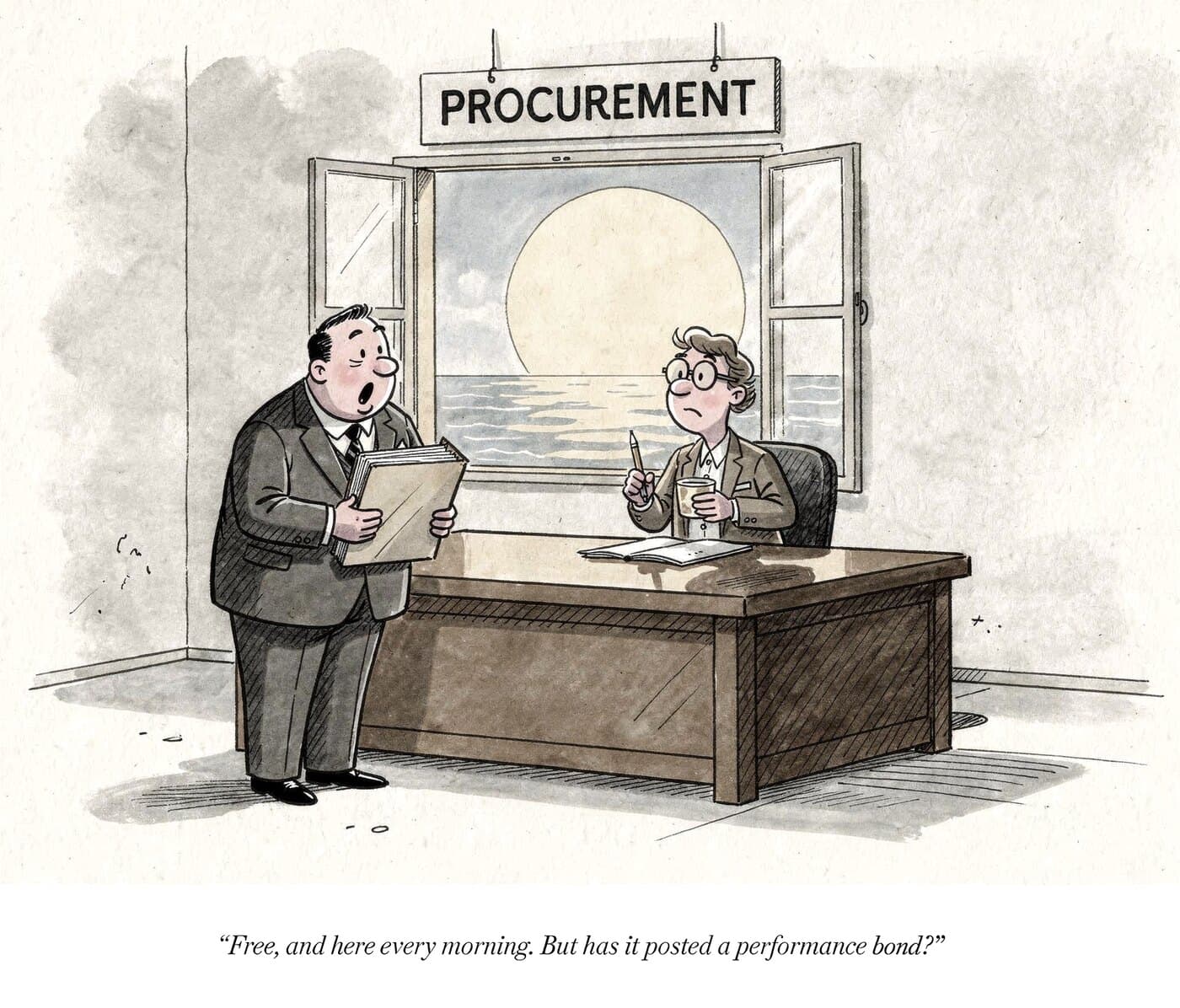
Sunlight is the closest thing Guam has to a local fuel. It arrives every morning without an invoice. Even when a foreign company builds and owns the plant that captures it, the arithmetic changes. When the 60-megawatt solar farm in Mangilao began delivering power in 2022, GPA paid 8.5 cents per kilowatt-hour for its energy while the fuel surcharge stood near 23 cents, a difference the utility said was saving ratepayers close to $2 million a month.9 Newer contracts, which include batteries to carry solar power into the night, come in at roughly 17 to 18 cents.10 On October 1 the fuel surcharge alone rose to about 28 cents, and even that does not recover the full cost of fuel.6
Some of every solar payment does leave the island, as the owner's profit and the cost of its financing. But a smaller payment leaves. The price is fixed for decades rather than reset with every shipment.
GPA is not standing still. Guam law requires half of the island's electricity to come from renewable sources by 2035, and in 2024 the National Renewable Energy Laboratory put the current share at about 13 percent.11 The difficulty is time, and most of that time is not spent building.
The Mangilao contract was signed in August 2018.12 Construction took twenty-five months,13 and power flowed four years after signing. The next round of solar procurement was won in open competition, then stalled when a losing bidder's protest went to court. By the time the government prevailed, the Navy had withdrawn the land, and the project was terminated.2 14 A second contract signed in 2018 was never built. When that contractor missed a critical deadline in 2025, the performance bond GPA moved to collect was $4.6 million,15 less than a single month's fuel shipment.4 The current round was announced in December 2022.16 Its largest plant is not expected to deliver power until February 2028.15
If the decision were mine, I would open the door to every company that can build solar and storage at scale, here or abroad. The work would go to whoever could deliver real capacity soonest at a fair price. The contract would bind that company to keep the capacity running.
The strongest objections deserve an honest hearing. Speed is how governments end up with bad contracts. The rules that slow procurement exist because public money has been misspent before, and a protest is sometimes the only way a real error comes to light. A fixed price can lose, too. In fiscal 2020, when oil was cheap, GPA spent about $177 million on production fuel, less than half what it spent three years later.17 In a year like that, a 17-cent contract can cost more than fuel. And tough penalties are not free; builders price their risk into their bids.
All of that is true. But a hedge that sometimes loses is still a hedge, and what households cannot absorb is the swing, not the average. A slightly higher bid from a builder who must deliver costs less than a low bid that never produces a kilowatt-hour. The cure for a careless fast process is not a slow one. It is a fast process that can be watched.
GPA and the Consolidated Commission on Utilities could write that process into the next solar solicitation. Every bid, every score, and every evaluator's reasoning could be published on the day of award, in the searchable form I described in The Unread Record. Any resident could then see why the winner won. The Legislature could set firm deadlines for protests on critical energy projects, as I proposed in The Storm That Does Not Pass. Delivery dates could be scored heavily and made enforceable. Damages would be sized to the fuel a late plant fails to replace, and performance security would be large enough that walking away costs more than finishing. Openness is what allows speed to be trusted. Enforceable obligations are what make speed real.
Follow the ripples the other way. A household that pays less in surcharge spends the difference here; in The Invisible Raise, I called that a raise no employer has to approve. A bakery that pays less for power can hold its prices, or even afford the extra pair of hands it has needed for months. A utility that no longer needs emergency credit to buy fuel can pay its bills on time, and its borrowing costs fall with its risk.
There is something close to grace in a source of energy that comes each morning, freely, whether or not anyone has earned it. Gratitude for a gift like that is best expressed by putting it to good use.
Professor Batchelder taught me to ask what happens next. Guam already knows what happens next if nothing changes; it has seen the answer on its bills for years. The better question is what happens next if the island moves quickly, in plain sight, and holds every builder to its word.
Footnotes
-
Frédéric Bastiat, "What Is Seen and What Is Not Seen" (1850), in Selected Essays on Political Economy, Library of Economics and Liberty. https://www.econlib.org/book-chapters/chapter-chapter-1-what-is-seen-and-what-is-not-seen/ ↩
-
Office of Public Accountability, "Guam Power Authority Financial Audit: FY 2023 Financial Highlights," May 21, 2024 (production fuel of $399.9 million; Phase III terminated after a prolonged bid protest and the Navy's repurposing of the site). https://gwosa2.opaguam.org/sites/default/files/gpahighlights23_0.pdf ↩ ↩2
-
"Power credits proposed, Guam energy program launched amid fuel price surge," Pacific Island Times, March 17, 2026. https://www.pacificislandtimes.com/post/power-credits-proposed-guam-energy-program-launched-amid-fuel-price-surge ↩
-
John O'Connor, "PUC approves fuel credit line," The Guam Daily Post, May 24, 2026 (credit line of up to $70 million for fuel only; March shipment about $26 million, April about $54 million; a 250,000-barrel shipment priced at about $44 million). https://www.postguam.com/news/local/puc-approves-fuel-credit-line/article_9412f9d6-52b7-49a1-97f5-000e2f4f5738.html ↩ ↩2 ↩3
-
Robert Slavin, "Guam Power Authority downgraded to Baa3 by Moody's," The Bond Buyer, October 1, 2026. https://www.bondbuyer.com/news/guam-power-authority-downgraded-to-baa3-by-moodys ↩
-
"Power bills to rise amid high fuel costs, joining other rate increases," The Guam Daily Post, September 18, 2026 (PUC approved a LEAC of about 28.27 cents per kWh, up from 19.4 cents, effective October 1; full cost recovery "isn't possible under current circumstances"). https://www.postguam.com/news/local/power-bills-to-rise-amid-high-fuel-costs-joining-other-rate-increases/article_7afe52d0-f0a6-4674-9f90-44946413dc29.html ↩ ↩2
-
Guam Business Privilege Tax Law, 11 GCA § 26202 (tax measured on gross proceeds of sales or gross income; rate reduced to 4 percent beginning October 1, 2026). https://law.justia.com/codes/guam/title-11/division-2/chapter-26/ ↩
-
Guam Procurement Law, 5 GCA § 5008, "Policy in Favor of Local Procurement." https://col.guamcourts.gov/sites/default/files/05gc005.pdf ↩
-
Guam Power Authority, Citizen-Centric Report, Fiscal Year 2022. https://gwosa2.opaguam.org/sites/default/files/gpa_ccr22.pdf ↩
-
John O'Connor, "CCU authorizes GPA to petition new renewable energy projects," The Guam Daily Post, August 28, 2024 (first-year Phase IV prices of about 17.3 and 17.9 cents per kWh). https://www.postguam.com/news/local/ccu-authorizes-gpa-to-petition-new-renewable-energy-projects/article_b55cccba-6448-11ef-a2b9-6307695ee31c.html ↩
-
National Renewable Energy Laboratory, "How Will Guam Achieve 100% Renewable Energy by 2045?" 2024. https://nrel.gov/news/program/2024/how-will-guam-achieve-100-renewable-energy-by-2045.html ↩
-
"GPA inks renewable energy projects with S. Korean firms," Pacific Island Times, September 7, 2018. https://www.pacificislandtimes.com/post/2018/09/07/gpa-signs-renewable-energy-deal-with-korean-power-firm ↩
-
"Guam eyes 100% renewable energy by 2045," Building Industry Hawaii, September 28, 2022 (construction began May 2020 and took 25 months). https://buildingindustryhawaii.com/?p=1113 ↩
-
John O'Connor, "Phase III solar project pending as Navy withdraws use of property," The Guam Daily Post, August 15, 2022. https://www.postguam.com/news/local/phase-iii-solar-project-pending-as-navy-withdraws-use-of-property/article_fbb7ae98-16eb-11ed-81c7-a7985be1ce54.html ↩
-
"Major solar project falls through," The Guam Daily Post, March 2025 ($4.6 million performance bond; 132 MW Phase IV project expected online February 28, 2028). https://www.postguam.com/news/local/major-solar-project-falls-through/article_4fdae23f-d71c-4081-a6df-20cff0c7d344.html ↩ ↩2
-
Consolidated Commission on Utilities, GPA Work Session Board Book, August 22, 2024, Resolution No. FY2024-29 (Phase IV Multi-Step Bid No. GPA-012-23 announced December 2022). https://guamccu.org/wp-content/uploads/2024/08/Board-Book-GPAWS-08-22-24_reduced-file_Part1.pdf ↩
-
Office of Public Accountability, "Guam Power Authority – FY 2020 Financial Highlights" (production fuel expense of $177 million in FY 2020). https://gwosa2.opaguam.org/sites/default/files/1_-_gpa_fy_2020_financial_highlights_final.pdf ↩