In late 1981, President Ronald Reagan's budget director said something in a magazine interview that nearly cost him his job. The administration's new tax cut, David Stockman told a reporter, was "always a Trojan horse to bring down the top rate."1
The idea inside that horse was older than the horse. Before anyone called it "trickle-down," economists called it the horse-and-sparrow theory: feed the horse enough oats, and some will pass through to the road for the sparrows. Cut taxes for those at the top, and they will invest, build, and hire, and the benefits will reach everyone else. Reagan sold his cut to Congress as a broad measure that would unleash growth, and over his presidency the top income tax rate fell from 70 percent to 28 percent.2
The retreat began almost immediately. As deficits swelled, Reagan signed a 1982 law scaling back much of the cut, followed by more revenue-raising laws in 1984 and 1987.3 To be fair, Reagan insisted the 1982 law was not a reversal of his philosophy.4 But the cuts had not paid for themselves, and the bill came due.
Kansas ran the experiment again in 2012, cutting taxes sharply and promising a surge. Growth trailed the national average every year the cuts lasted, revenue fell short, and in 2017 a Republican legislature repealed most of them over the governor's veto.5 Across 18 wealthy nations and fifty years of major tax cuts for the rich, researchers at the London School of Economics and King's College London found that inequality rose while growth and unemployment showed no significant change.6 Princeton economist Owen Zidar found that job growth after U.S. tax cuts came largely from relief for lower- and middle-income households, with little from cuts for the top 10 percent.7
The sparrows, it turns out, mostly go hungry. Money handed to those who already have plenty does not reliably become new jobs.
Guam's Business Privilege Tax is another story altogether, and in one sense the mirror image of trickle-down: a tax that asks the most of those with the least to spare.
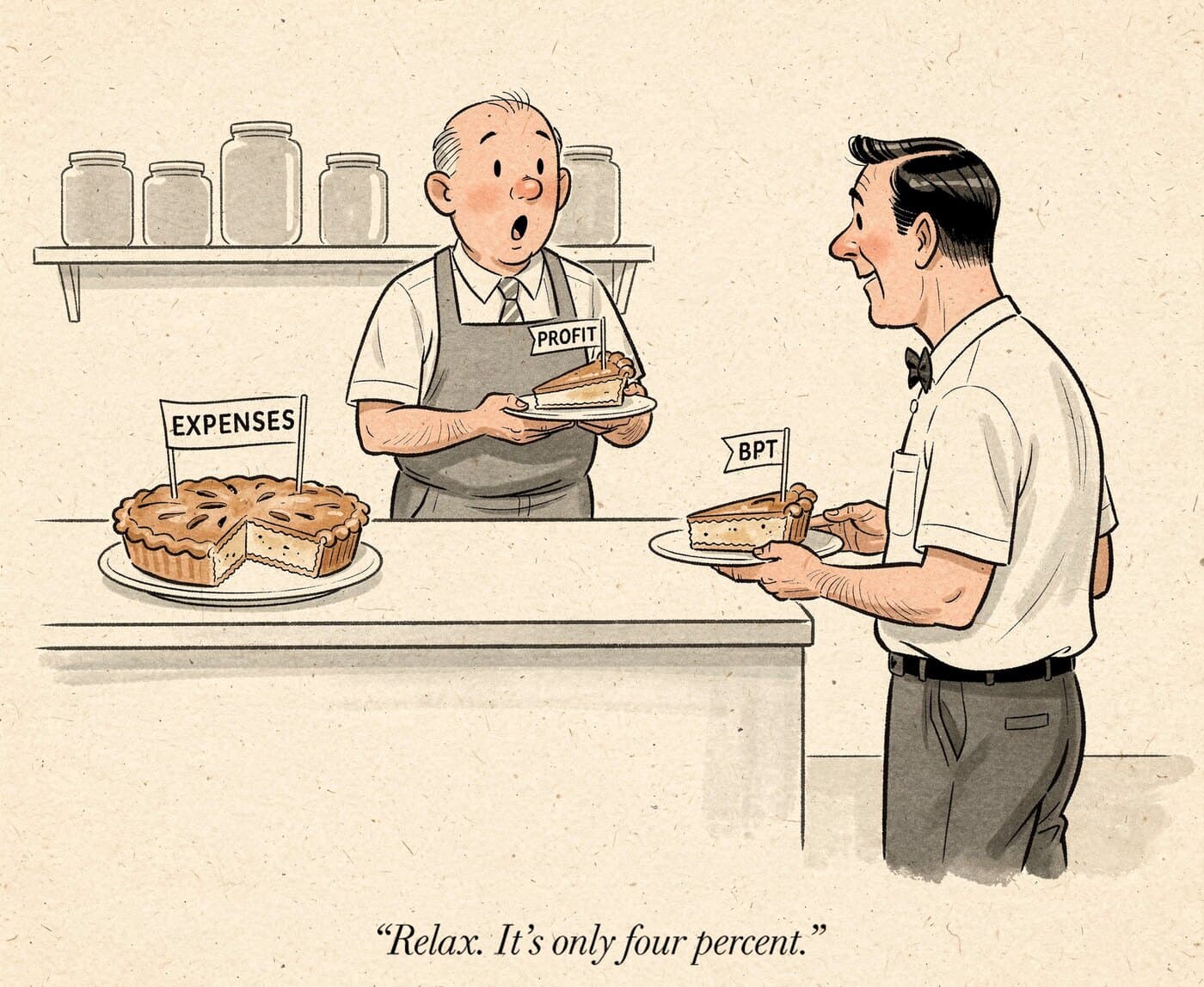
To many residents, the BPT sounds like just another tax. It is not. Businesses on Guam already pay an income tax that mirrors the federal code, levied on profit: what remains after wages, rent, inventory, and equipment are paid.8 The BPT is levied on gross receipts, every dollar that comes through the door. It never asks whether the business made money.9 On October 1, the general rate fell to 4 percent, unwinding a 5 percent rate adopted in 2018 to replace revenue Guam lost when the 2017 federal tax cut, mirrored into local law, lowered income taxes on the island.10
That difference decides what an owner is rewarded for doing.
Under a profit-based tax, reinvestment lowers the bill. A new worker's wage is deductible. A faster oven, a second delivery truck, or better software is written off over time. Each becomes an asset that lets the business do more with less. When Congress let firms deduct equipment faster, a study of more than 120,000 firms found eligible investment rose 10 to 17 percent, with small firms responding most.11
The BPT notices none of it. The new worker's wages reduce nothing. The new oven reduces nothing. If the investment pays off and sales grow, the tax grows with them.
For a struggling business, the effect can be decisive. In a Tax Foundation illustration, a 1 percent gross receipts tax consumes 20 percent of the profit of a grocer earning a 5 percent margin.12 By the same arithmetic, a 4 percent BPT equals 80 percent of the grocer's profit; even the reduced 3 percent rate most small businesses pay takes 60 percent.13 A business that broke even, or lost money, still owes the full amount.
For an owner at the kitchen table after a hard year, weighing whether to sign another lease, the BPT can be the weight that tips the scale toward closing.
New businesses feel this most. Nationally, roughly one in five new establishments closes within its first year.14 Under a profit-based tax, a young business owes no income tax until it turns a profit, and its early losses can be carried forward to offset future profits.15 That breathing room lets a business take root before it is asked to carry its full share. Under the BPT, once a business clears a small exemption, the tax is due on every sale, profitable or not.13
The same logic reaches every building on the island. Rent is subject to the BPT, so a landlord pays on every dollar of it.9 Guam's income tax lets an owner deduct routine repairs such as fresh paint, a patched roof, or a fixed railing, so the government shares part of the cost of keeping a building sound.16 The BPT, levied alongside it, shares none. A gallon of paint reduces nothing. The owner who stops at the code minimum and the owner who paints, repairs, and adds years to the building's life owe the same BPT on the same rent.
Guam can see the result. Lawmakers have put the problem in writing: neglect, one bill found, has left many unsafe structures that blight the island's landscape.17 At the far end of that neglect stand buildings like the long-abandoned Verona Resort, visible from Marine Corps Drive as lawmakers weigh maintenance standards for Tumon.18 No tax alone explains a weathered building; salt air and typhoons are hard on concrete and steel. But a tax system should reward upkeep, not ignore it.
The BPT has serious defenders, and they have a point. Gross receipts taxes, they note, are simple to administer and steadier than profit-based taxes, which fall sharply in a recession.19 The governor's office adds that about 90 percent of businesses already pay a reduced 3 percent rate, and that most full-rate payers are large international firms tied to the military buildup.13 Guam also cannot freely rewrite its income tax; the mirror code is set in Washington.8 The BPT, defenders add, is among the few levers the Legislature controls, and it reaches large off-island firms whose profits could otherwise be booked elsewhere.
Yet a lower rate on the wrong base is still the wrong base; even at 3 percent, the thin-margin grocer surrenders most of its profit. And convenience for the tax collector should never be the goal. The measure of a good tax is whether it raises what government truly needs with the least possible harm to the economy that pays it. Stability has its own cost. When the economy falters, a tax that holds the government harmless shifts the entire hardship onto households and businesses. A government that shares the lean years, tightening its own spending, helps preserve the economy it depends on. Tax that economy into the ground, and there will be nothing left to tax.
Guam should stop taxing revenue and replace the BPT with a tax on profit. Every business already calculates its profit and its income tax liability under the mirror code.8 Guam could levy its own business tax as a set percentage of that liability, including profits that pass through to owners' returns. The Legislature should direct the Department of Revenue and Taxation to study and recommend a rate that equals the revenue the BPT is expected to raise, with safeguards against profits shifted off-island.
North Dakota, Rhode Island, and Vermont used this method for their income taxes as recently as 2001.20 It carries one known risk: when Congress changes federal liability, local revenue moves with it, as Guam learned in 2018. A phase-in, beginning with new small businesses and paired with tighter government spending, would ease the transition.
I would welcome the chance to pay taxes in the highest bracket, because it would mean my work had been blessed with abundance. My faith teaches that those who are given much are expected to look after those who cannot look after themselves: the widow, the orphan, the stranger, the sick. To me, a higher rate on those who can afford it is one way a society writes that teaching into law. It does not replace personal generosity, but it springs from the same conviction: abundance carries obligation.
Trickle-down asked too little of those with the most and promised that others would benefit. A gross receipts tax asks the most of those with the least margin to spare. A wiser tax would ask the one question the BPT never does—what truly remains?—and give a young business time to grow into a neighbor that hires, serves, and contributes in its turn.
Footnotes
-
TIME, "What Stockman Said," November 23, 1981. https://time.com/archive/6856563/what-stockman-said/ ↩
-
Chris Edwards, "Reagan's Budget Legacy," Cato Institute. https://www.cato.org/commentary/reagans-budget-legacy ↩
-
Center on Budget and Policy Priorities, "How the Bush Tax Cut Compares in Size to the Reagan Tax Cuts," February 2001. https://cbpp.org/archives/2-6-01tax2.htm; Cato Institute, "Reagan's Budget Legacy." https://www.cato.org/commentary/reagans-budget-legacy ↩
-
Ronald Reagan, "Address on Tax and Budget Legislation," August 16, 1982, Miller Center, University of Virginia. https://millercenter.org/the-presidency/presidential-speeches/august-16-1982-address-tax-and-budget-legislation ↩
-
KCUR, "Fact Check: Delving Into Brownback's Defense of Tax Cuts," June 9, 2017. https://www.kcur.org/government/2017-06-09/fact-check-delving-into-brownbacks-defense-of-tax-cuts; KCUR, "Brownback Tax Cut Era Ends With Kansas Legislature's Veto Override," June 7, 2017. https://www.kcur.org/government/2017-06-07/brownback-tax-cut-era-ends-with-kansas-legislatures-veto-override ↩
-
David Hope and Julian Limberg, "The Economic Consequences of Major Tax Cuts for the Rich," LSE International Inequalities Institute Working Paper 55 (2020); published in Socio-Economic Review (2022). https://eprints.lse.ac.uk/107919/1/Hope_economic_consequences_of_major_tax_cuts_published.pdf ↩
-
Owen Zidar, "Tax Cuts for Whom? Heterogeneous Effects of Income Tax Changes on Growth and Employment," Journal of Political Economy 127, no. 3 (2019): 1437–1472. https://oar.princeton.edu/handle/88435/pr12b73?mode=full ↩
-
48 U.S.C. § 1421i, "Income tax" (Organic Act of Guam), U.S. Government Publishing Office. https://www.govinfo.gov/link/uscode/48/1421i ↩ ↩2 ↩3
-
11 GCA Chapter 26, "Business Privilege Tax Law," via Justia. https://statecodesfiles.justia.com/guam/2022/title-11/division-2/chapter-26/chapter-26.pdf?ts=1675437678 ↩ ↩2
-
Marianas Business Journal, "Guam legislature passes $1.42B FY2027 budget bill with 4% BPT rollback." https://www.mbjguam.com/guam-legislature-passes-142b-fy2027-budget-bill-4-bpt-rollback; 38th Guam Legislature, Bill No. 11-38 (COR), legislative findings. https://guamlegislature.gov/38th_Guam_Legislature/Bills_Introduced_38th/Bill%20No.%2011-38%20(COR)%20Referred%20Version.pdf ↩
-
Eric Zwick and James Mahon, "Tax Policy and Heterogeneous Investment Behavior," American Economic Review 107, no. 1 (2017): 217–248. https://www.aeaweb.org/articles?id=10.1257%2Faer.20140855 ↩
-
Tax Foundation, "Tax Pyramiding: The Economic Consequences of Gross Receipts Taxes" (Special Report No. 147). https://files.taxfoundation.org/legacy/docs/sr147.pdf ↩
-
Office of the Governor of Guam, "Governor's Statement on BPT: Reduction in BPT Does Not Reduce Prices." https://governor.guam.gov/press_release/governors-statement-on-bpt-reduction-in-bpt-does-not-reduce-prices/ ↩ ↩2 ↩3
-
U.S. Bureau of Labor Statistics, "34.7 percent of business establishments born in 2013 were still operating in 2023," The Economics Daily, 2024. https://www.bls.gov/opub/ted/2024/34-7-percent-of-business-establishments-born-in-2013-were-still-operating-in-2023.htm ↩
-
Internal Revenue Service, Publication 536, "Net Operating Losses (NOLs) for Individuals, Estates, and Trusts." https://www.irs.gov/publications/p536 ↩
-
Internal Revenue Service, Publication 527, "Residential Rental Property," Repairs and Improvements. https://www.irs.gov/publications/p527 ↩
-
32nd Guam Legislature, Bill No. 267-32 (COR), legislative findings. https://archives.guamlegislature.gov/32nd_Guam_Legislature/Referral_32nd/Referral%20B267-32%20(COR).pdf ↩
-
Isla Public Media, "Tourism officials, lawmakers support hotel maintenance standards," July 28, 2025. https://www.islapublic.org/news/2025-07-28/tourism-officials-lawmakers-support-hotel-maintenance-standards ↩
-
Tax Foundation, "Gross Receipts Taxes: An Assessment of Their Costs and Consequences." https://taxfoundation.org/research/all/federal/gross-receipts-tax/ ↩
-
Tax Policy Center, "How do state individual income taxes conform with federal income taxes?" Tax Policy Center Briefing Book. https://taxpolicycenter.org/briefing-book/how-do-state-individual-income-taxes-conform-federal-income-taxes ↩