Since the first of October, the fuel charge on a Guam household’s power bill has been more than double what it was in June. For a family that uses 1,000 kilowatt-hours a month, the difference comes to about $147.1 Behind the number is a tanker. Fuel that cost the Guam Power Authority about $88 a barrel in January cost more than $222 in April, after the war with Iran and the closing of the Strait of Hormuz.2
Each cargo has to be paid for before customers’ bills catch up, so in May regulators let the utility open a line of credit of up to $70 million to keep paying.3 By mid-September, nearly four months later, the utility described that line of credit in five words: “currently in the procurement process.”4 As September ended, it still had not opened.5
I do not know what slowed it, and I would not assume that anyone at the utility sat idle. But with the lights at stake and no one disputing the need, the tool for paying had been a season in the buying. It is fair to wonder about the pace of everything else.
Two cases I have written about before suggest an answer. In early May, attackers encrypted and defaced several government websites while the support contract for the vendor that ran them was still in procurement. The vendor had recommended patches months earlier, the acting chief technology officer later told a legislative oversight hearing, and the office had been waiting on a purchase order to apply them.6 And last November, Public Works itself said that repeated procurement challenges had delayed a new Simon Sanchez High School for more than a decade, while thousands of students sat through double sessions.7
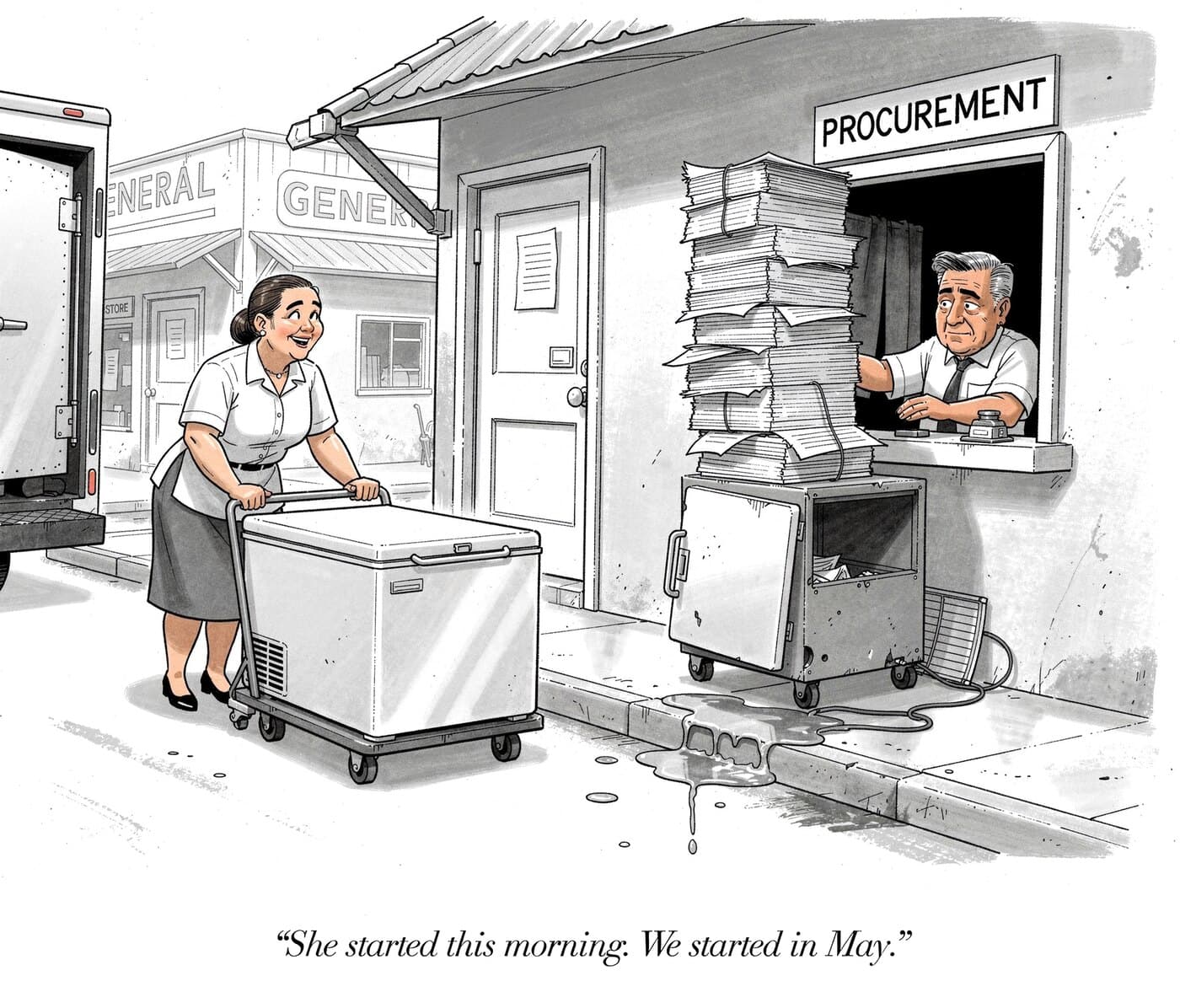
The way the owner of a small store buys a freezer is worth watching. She knows what she needs, because she has been nursing the old one for years. She calls two or three suppliers she has dealt with before. She asks the price, and then she asks how much power the thing draws, because she is the one who opens the power bill. By the afternoon she has decided. No committee met, no affidavit was notarized, and yet nothing about the purchase was careless. She was quick because the money was hers, and she was careful for the same reason.
That is most of what there is to know about how a well-run business buys. The person spending answers to an owner who can see, and the owner never asks how many forms a purchase cleared, only what it cost, when it arrived, and whether it worked.
Government cannot buy that way, and the reason deserves respect. The money belongs to the public, and the public cannot stand at the counter. A shopkeeper may favor her cousin; a government must not. So in 1983 Guam put into effect a procurement law built on a national model code, and it set procedure where the owner’s eye would have been: sealed bids, written determinations, the right to protest.8 That is what the paperwork was for. The law’s own commentary called the rules it replaced vague, and admitted, with a candor I admire, that the new ones would “somewhat complicate” matters.9
It was a fair trade, and the case for keeping it is strong. On a small island, where a purchasing clerk may well know the vendors personally, firm rules protect the honest employee as much as the taxpayer. And Guam has seen an unwatched fast lane before. In 2004 the Public Auditor reported that small purchases, the law’s quick lane, made up 95 percent of the purchase orders the General Services Agency issued over twenty-one months. Orders appeared to have been split to stay under the bidding threshold, nineteen of them to one vendor in a single day.10 Speed without sight is how public money goes missing. On that point, the defenders of the rules are right.
But procedure was meant to fill the gap left by owners who cannot watch over the spending as it happens, and it fills that gap slowly. Paper can show that a process was followed; it cannot show that the public got its money’s worth. And when the careful road proves too slow, the remedy so far has been one exception after another. In 2023 lawmakers created a special protest track for large federally funded projects. In 2024 they waived certain procurement rules so the power authority could bring in temporary generators. In 2025 they raised the small-purchase ceiling for the public health department to $250,000, ten times the general limit.11 Each was reasonable. Each was also an admission that the main road is too slow, and none changed how much the public can see.
Changing that is the better bargain, with every step toward speed paid for by a step toward sight. A resident who wondered about the fuel credit should be able to open one page and find which lenders were asked, what they offered, who chose and why, and how many days each step took. It took an audit to find those nineteen orders to one vendor; on such a page they would appear within the week, for any reporter or rival vendor to notice. Ukraine rebuilt its public purchasing on the rule that everyone sees everything, and by the end of 2020 had counted more than $6 billion in savings.12
Sight would shorten fights, too. The protest that halted Simon Sanchez last November turned on whether the procurement record had been complete and on time;13 a record kept in public from the first day leaves little to argue about on that score. A protest must remain a right, but it should be decided on a deadline, as federal protests are, within 100 days.14
Guam’s law already promises this. Its stated purposes include the most value for public funds and public access to all aspects of procurement.15 Keeping that promise as a matter of routine would make faster lanes safe.
Once the owners can see, the buyers can move the way a business does. In the autumn of 1983, the season Guam’s law took effect, Peter Kraljic of McKinsey argued in the Harvard Business Review that companies should stop treating all purchases alike and handle each according to its stakes and the risk to its supply.16 Three habits that follow from that idea would serve Guam well.
The first is to match the process to the stakes. Toner does not need the scrutiny a power plant does, and a security patch should not wait months for a purchase order. Hawaii lets agencies use small-purchase procedures for goods and services under $100,000, four times Guam’s ceiling, but its executive agencies must run purchases of $15,000 and up through an online system, and awards of $2,500 or more are posted publicly.17 The lane is wider, and it is lit.
The second is to compete once and buy many times. The shopkeeper does not shop for receipt paper every week; she has a supplier and a price, and she orders against it. The Public Auditor urged that kind of planning in 2004, and found in 2011 and again in 2017 that it was still not working.18 Guam’s code already lets a few public health and welfare programs join contracts that other governments have competitively bid.19 That door could open to every agency.
The third is to count the whole cost. The shopkeeper asks about the power draw; a rule that weighs only the sticker price does not. Guam’s law already tells the government to weigh total cost of ownership, fuel economy included, when it buys vehicles, and it allows life-cycle cost as a measure in any sealed bid.20 With the fuel charge where it is, the cheapest air conditioner on the bid sheet may be the most expensive one the government ever owns.
The shopkeeper is quick and careful because she spends her own money in her own sight. The people of Guam are owners too, of every dollar their government spends, whether it is raised through taxes or, like the fuel credit, repaid through power bills. Whoever holds office in January could begin with that one page: let the owners see, and then let the buyers move.
Disclosure: The author owns SK102, a technology consulting firm on Guam that could seek government technology work of the kind described here.
Footnotes
-
Guam Power Authority, “Levelized Energy Adjustment Clause (LEAC),” rate table for secondary (distribution-level) customers: $0.135840 per kWh effective January 1, 2026; $0.194150 effective July 1, 2026; $0.282708 effective October 1, 2026. The difference between the rate in effect through June and the October rate, $0.146868 per kWh, comes to $146.87 on 1,000 kWh (author’s arithmetic). https://www.guampowerauthority.com/leac. As a cross-check, The Guam Daily Post estimated the October step alone at about $88 for an average residential bill, which matches the July-to-October difference on 1,000 kWh: John O’Connor, “Proposed LEAC hike would raise average residential bill by $88,” September 2026. https://www.postguam.com/news/local/proposed-leac-hike-would-raise-average-residential-bill-by-88/article_7f04cf06-aaa0-4833-93c3-505d7229d603.html ↩
-
Guam Power Authority, “GPA Proposes to Defer Interim LEAC Adjustment,” press release, September 15, 2026 (average fuel cost of about $88 per barrel in January and more than $222 per barrel in April). https://fe40979c-838a-406f-a7ed-25d2b7816fd5.usrfiles.com/ugd/fe4097_ebb6a63e9a164e2db1fb8360208040d0.pdf. On the war with Iran and the closing of the Strait of Hormuz as the cause of the increase, see note 3. ↩
-
John O’Connor, “PUC approves fuel credit line,” The Guam Daily Post, May 2026 (approval of a line of credit of up to $70 million so the utility can keep paying for fuel before the cost is recovered through customer bills). https://www.postguam.com/news/local/puc-approves-fuel-credit-line/article_9412f9d6-52b7-49a1-97f5-000e2f4f5738.html ↩
-
Guam Power Authority, press release, September 15, 2026 (see note 2), describing the line of credit, approved by the Consolidated Commission on Utilities and the Public Utilities Commission, as currently in the procurement process. ↩
-
The Bond Buyer, “Guam Power Authority downgraded to Baa3 by Moody’s,” October 2026 (reporting Moody’s expectation that the authority would open a line of credit in the near term). https://www.bondbuyer.com/news/guam-power-authority-downgraded-to-baa3-by-moodys. On the procurement still being open in mid-September: “Power bills to rise amid high fuel costs, joining other rate increases,” The Guam Daily Post, September 2026. https://www.postguam.com/news/local/power-bills-to-rise-amid-high-fuel-costs-joining-other-rate-increases/article_7afe52d0-f0a6-4674-9f90-44946413dc29.html ↩
-
Isla Public Media, “Office of Technology asks for rapid procurement plan for cyber-emergencies,” May 27, 2026 (reporting that vendor-managed government websites were encrypted and defaced while the vendor’s support contract was in procurement, and quoting the acting chief technology officer’s testimony on the recommended patches). https://www.islapublic.org/news/2026-05-27/office-of-technology-asks-for-rapid-procurement-plan-for-cyber-emergencies. On the timing of the attack: Guam Homeland Security/Office of Civil Defense, “Government of Guam Activates Cyber Incident Response; Global Vulnerability Under Investigation,” press release, May 2, 2026. https://ghs.guam.gov/sites/default/files/press_release_-_government_of_guam_activates_cyber_incident_response_global_vulnerability_under_investigation.pdf ↩
-
Skyler Obispo, “General Pacific Services files procurement protest, Sanchez build halted,” Marianas Business Journal, November 2025 (quoting the Department of Public Works’ statement on more than a decade of procurement challenges). https://www.mbjguam.com/general-pacific-services-files-procurement-protest-sanchez-build-halted. On double sessions: “DPW releases complete procurement record for $167M Sanchez rebuild project,” Marianas Business Journal, December 2025 (about 3,000 students at Simon Sanchez and John F. Kennedy high schools attending double sessions). https://www.mbjguam.com/dpw-releases-complete-procurement-record-167m-sanchez-rebuild-project ↩
-
5 GCA Chapter 5 (Guam Procurement Law): introductory Comment (the chapter is essentially the Model Procurement Code approved by the American Bar Association in 1979); § 5009 (effective October 1, 1983); § 5211 (competitive sealed bidding); § 5020 (written determinations); § 5425 (protests). https://law.justia.com/codes/guam/title-5/division-1/chapter-5/ ↩
-
5 GCA § 5001, Comment (see note 8). ↩
-
Office of Public Accountability, General Services Agency Small Purchases Procurement Function, OPA Report No. 04-05, Executive Summary (March 2004). The audit covered October 1, 2001 through June 30, 2003, and described the division of purchases as possible rather than proven. https://gwosa2.opaguam.org/sites/default/files/opa0405es_0.pdf ↩
-
Public Law 37-51 (December 13, 2023), adding 5 GCA §§ 5428 and 5429 on critical procurement contracts expected to cost $5 million or more using American Rescue Plan Act or Infrastructure Investment and Jobs Act funds: https://www.guamlegislature.com/37th_Guam_Legislature/Public_Laws_37th/Public%20Law%20No.%2037-51.pdf. On Public Law 37-81 and the Guam Power Authority’s temporary power contract: “Guam’s emergency power deal fails to stand up to attorney general’s scrutiny,” Pacific Island Times, March 2024, https://pacificislandtimes.com/post/guam-s-emergency-power-procurement-hits-a-snag. On the small-purchase limits: 5 GCA § 5117.2 (Department of Public Health and Social Services, up to $250,000; added by P.L. 38-60, September 29, 2025) and § 5213 (general limit of $25,000 for supplies and services) (see note 8). ↩
-
Open Contracting Partnership, “Ukraine: Everyone sees everything.” https://www.open-contracting.org/impact-ukraine ↩
-
See note 7: the December 2025 Marianas Business Journal report that General Pacific Services said it filed the protest because the Department of Public Works had not initially provided a complete procurement record, and that the protest triggered an automatic stay. ↩
-
Congressional Research Service, GAO Bid Protests: An Overview of Time Frames and Procedures, Report R40228 (the Government Accountability Office is required by statute to issue final decisions within 65 to 100 days of a protest’s filing). https://www.everycrsreport.com/reports/R40228.html ↩
-
5 GCA § 5001(b)(5) and (b)(8) (see note 8). ↩
-
Peter Kraljic, “Purchasing Must Become Supply Management,” Harvard Business Review, September–October 1983. https://hbr.org/1983/09/purchasing-must-become-supply-management ↩
-
Hawaii State Procurement Office, “Small Purchases Procurement Method,” https://spo.hawaii.gov/for-vendors/vendor-guide/methods-of-procurement/goods-services-construction/small-purchases-procurement-method; and Procurement Wizard, § 4.2, “Small Purchases Process,” https://spo.hawaii.gov/procurement-wizard/?p=381. Guam’s ceiling of $25,000 for supplies and services is at 5 GCA § 5213 (see note 8). ↩
-
OPA Report No. 04-05 (see note 10); Office of Public Accountability, General Services Agency Small Purchases Procurement Follow-Up Audit, OPA Report No. 11-12, Executive Summary (December 2011), https://gwosa2.opaguam.org/sites/default/files/opa1112es.pdf; and General Services Agency Procurement Practices, OPA Report No. 17-05, Executive Summary (2017), https://opaguam.org/sites/default/files/opa_17-05es.pdf ↩
-
5 GCA §§ 5126 and 5126.1 (see note 8), covering the Women, Infants, and Children Program, the Bureau of Economic Security, and the Division of Public Welfare, and requiring a written finding that the other government’s contract was competitively procured. ↩
-
5 GCA § 5123(a) (vehicle purchases; total cost of ownership) and § 5211(e) (bid evaluation criteria may include total or life-cycle costs) (see note 8). ↩