Last November, an airliner left Busan for Guam with a hundred and eighty seats and three passengers. Six airline employees made the trip as well, outnumbering the customers two to one.1 The flight was not a scheduling error. When Korea's antitrust regulator approved the merger of Korean Air and Asiana, it required the combined group's carriers to keep flying Guam at ninety per cent of their 2019 capacity. The rule could guarantee the seats. It could not guarantee anyone who wanted to sit in them.
In September, five of those airlines asked to cut back to seventy per cent, citing weak demand. A commission examiner has recommended refusing them, and a final decision is pending.1 For now, the planes will keep coming, lightly loaded, to an island whose largest private industry depends on them.2
On Guam, those empty seats have mostly been read as a demand problem, and the answer has been to buy more flights and run more ads. The Legislature approved ten million dollars for airline incentives and marketing.3 The Guam Visitors Bureau advertised aboard Korean Air flights, ran cashback offers with payment companies, and backed fare discounts on the Busan route.4 I saw the effort myself. Running on a treadmill at a gym in Korea, I looked up at the wall screen and there was Guam: turquoise water, white sand, a family laughing in the surf. Someone had worked hard on that ad, and it showed.
For a while, it worked. December, 2025, brought 95,141 visitors, the island's best month since the pandemic.5 Then came Super Typhoon Sinlaku in April, higher jet-fuel surcharges, and fewer seats from Korea.6 Fares climbed, and by July arrivals had fallen thirty-seven per cent from a year earlier.4 Shocks like these strike every destination. The ones with loyal repeat visitors recover; the ones whose demand was bought wait for the next subsidy.
The family in what follows is a composite. Each thing that happens to them, though, has happened, or is there to be seen.
They live in Busan. The father saw the ad, and the fare was easy to like, helped along by the discounts Guam had paid for. The hotel rates were harder. Four nights in Tumon cost more than he had hoped, and he let the booking page sit open for a week. Then his wife pointed out that their children had never seen water that color. They booked.
The air, when they land, is warm and soft, exactly as advertised. The ride to the hotel is less so. The road from the airport is patched and uneven. Lane lines have faded to suggestions. The grass on the medians has been mowed, but weeds grow untouched from the cracks, and the curb paint has nearly worn away. Near the end of the ride, the van passes the empty shell of the Verona Resort.7 The children, looking out the window, are quiet.
The next morning, Guam keeps its promise. Tumon Bay is clear and calm, and the children do not want to leave the water. If the trip were only the beach, there would be nothing to write about.
At midday, they walk San Vitores Road looking for lunch. Many storefronts are shuttered, and when they look up, the paint on the upper floors is peeling. The signs over the doorways come in every size and style, as if no one ever agreed on what the street should look like. Up the road, a tall resort stands dark. It is the Pacific Star, 436 rooms, closed since its owner went bankrupt; a buyer has promised a renovation but named no reopening date.8 Farther along, DFS Galleria, the duty-free emporium that anchored Tumon for fifty-five years, has been closed since the end of March. Tumon Sands Plaza, which once housed twenty-one designer boutiques, has emptied out.9 In Busan, the mother says, buildings like these would be assumed abandoned.
On the second day, they want to see the waterfalls and quiet villages of the south. The red shuttle serves Tumon, the malls, and a few sights nearby, and when it is full it passes the stop.10 Beyond that, Guam has little public transportation.2 So the father rents a car. Without clear lane markings, and among drivers who do not always signal their intentions, he grips the wheel more than he enjoys the view. His wife has read that, in February, a Korean family with an infant was robbed at gunpoint, in daylight, outside a mall in Tamuning.11 After dark, they stay on the well-lit blocks near the hotel.
Dinner is the last surprise. The father converts the bill to won twice, to be sure. The designer shopping that once drew Asian travelers to Guam has largely gone, so on the last afternoon they browse the discount racks instead.
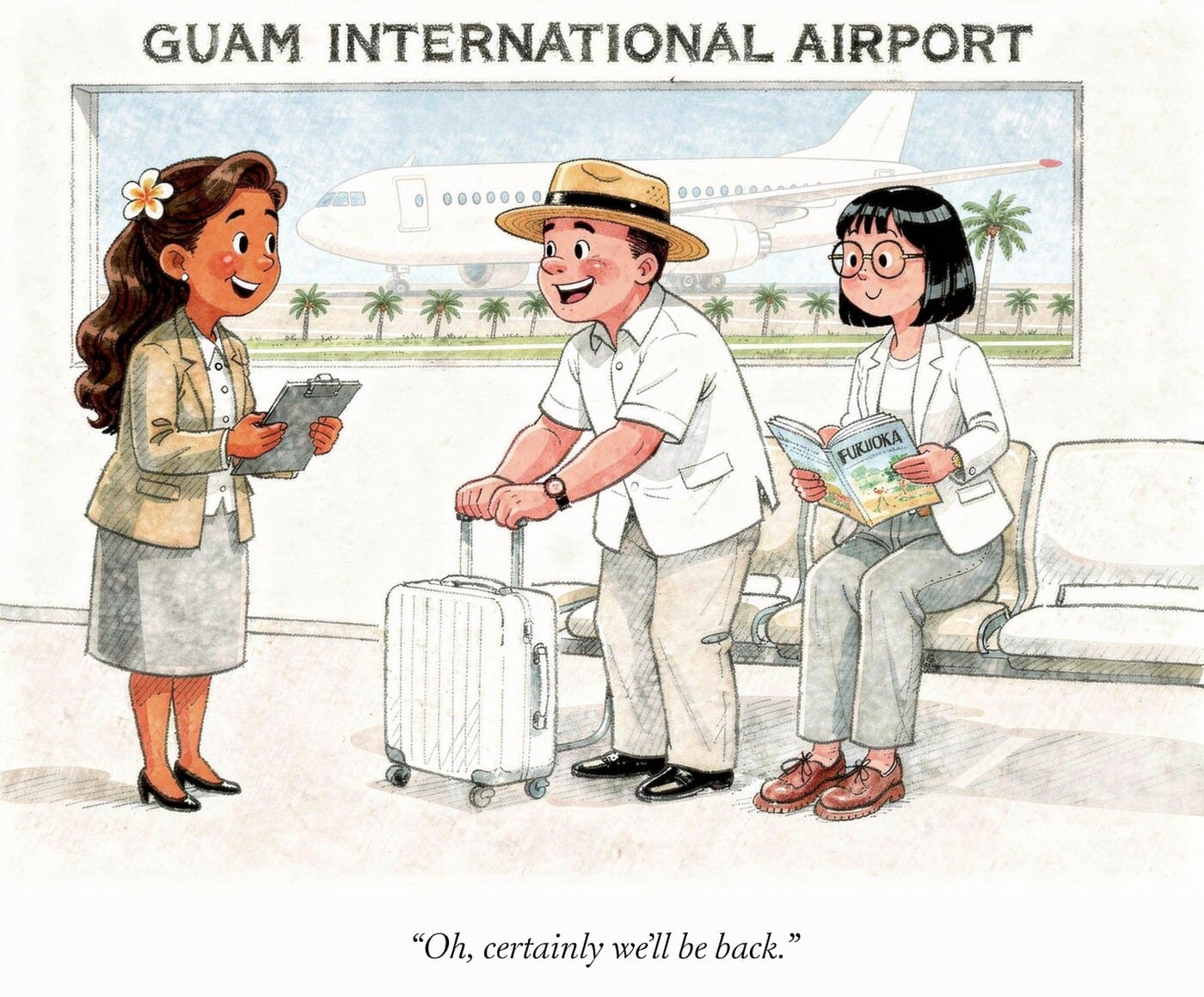
At the airport, a young woman with a tablet asks whether they are likely to come back to Guam. The father says yes. The beach was beautiful, the people at the hotel were kind, and he is a polite man. On the flight home, he and his wife start talking about Fukuoka. It is less than an hour from Busan, the yen is weak, and Korean travelers are economizing almost everywhere except Japan.12 Last year, 9.46 million Koreans visited Japan, nearly seventy per cent more than before the pandemic.13
That polite yes is in the bureau's numbers. When it surveyed departing visitors in 2025, ninety-four per cent of Koreans and Japanese said they were likely to come back.14 Yet the same survey recorded their chief complaints, road conditions and transportation, and that May, arrivals were still fifty-seven and a half per cent below 2019.14
The two facts fit together once a pleasant goodbye is no longer mistaken for a promise. People leave fond of Guam's beaches and its genuinely warm people, and then, the next time they have four days and a budget, they choose Fukuoka. Close to forty per cent of Korean visitors in 2019 had been to Guam before.15 That loyalty was the island's real inheritance, and it is being spent down.
The bureau has not been idle. It revived a Sunday night market in Tumon that visitors and residents both enjoy,16 and it pushed for the property law described below. Its board's draft recovery plan even lists "product decline" among the industry's four key challenges.17 The problem has been named. It has not been funded. The bureau's 2027 budget request puts about forty-four per cent into marketing and about twenty-eight per cent into everything visitors touch on the ground: beautification, cultural events, and safety.18 And the bureau does not pave roads, police Tumon, or regulate signs. No single agency can fix this alone.
Guam has, in fact, written this warning into law before. In the nineteen-nineties, the Legislature declared that Tumon had to be revitalized because rival destinations were outmarketing the island.19 Three decades later, the rivals are still winning.
The tools to change this are closer than they look. In June, at the bureau board's request, the governor signed a law applying the International Property Maintenance Code to Tumon's hotel zone. It takes effect next June.20 A 2022 law already lets Public Works fine the owners of unsafe abandoned buildings five thousand dollars and set deadlines to repair or demolish them.21 The same draft recovery plan priced immediate island-wide destination improvements at fourteen million dollars or more, four million more than the island found for airline incentives and marketing.17
The signs along San Vitores Road could follow a standard, too. Some municipalities require approval before a new sign or façade goes up in a commercial district. In Brookline, Massachusetts, the design must follow the town's guidelines and pass review by its Planning Board.22 Others require the old sign to come down when a business leaves; in Breckenridge, Colorado, it must be removed within fourteen days.23 A shuttered storefront with its old sign still hanging announces decline. A clean, freshly painted empty space suggests that someone expects the next tenant. Tumon could adopt a standard of its own, drafted with the shopkeepers who must meet it.
What is missing is the sequence. Next June, a Public Works inspector could walk San Vitores Road with the new code in one hand and, in the other, a public list of derelict buildings, the Verona near the top. Behind that inspector would stand a Legislature that funds the road from the airport as faithfully as it funds the seats. And the bureau could measure not only how many visitors arrive but how many return. An island cannot close the gap between "I'll be back" and the booking that never comes if it cannot see that gap.
Many of us were raised to believe that hospitality begins before the guest knocks: with the swept floor, the fresh linen, the table set with care. It is love made practical. Guam's visitors already find warmth in its people, at the hotel desk and on the beach. What they need now is to find it in the place itself. That will take landowners, hoteliers, restaurateurs, and residents deciding that the street outside belongs to them, too.
A regulator in Seoul can keep the seats on the plane. Only Guam can give people a reason to sit in them.
Footnotes
-
Seoul Economic Daily, "FTC Examiner Recommends Rejecting Airlines' Bid to Cut Guam Seat Requirement," September 30, 2026. https://en.sedaily.com/culture/2026/09/30/regulator-rejects-airlines-bid-to-cut-guam-seat-requirement ↩ ↩2
-
PKF hospitality LLC, Update – Tourism Recovery Plan for the Government of Guam, Bureau of Statistics and Plans, December 2024, pp. 2, 23–26. https://bsp.guam.gov/wp-content/uploads/2026/09/Updated-Guam-Tourism-Recovery-Plan_December-17-2024-1.pdf ↩ ↩2
-
The Guam Daily Post, "Tourism chief is 'very optimistic,'" January 2026. https://www.postguam.com/news/local/tourism-chief-is-very-optimistic/article_dab03ae3-4be6-4d1d-9ef4-1e77daf79fc8.html ↩
-
Isla Public Media, "Guam tourism arrivals down 37 percent in July as GVB targets key markets," September 9, 2026. https://www.islapublic.org/news/2026-09-09/guam-tourism-arrivals-down-37-percent-in-july-as-gvb-targets-key-markets ↩ ↩2
-
Guam Visitors Bureau, "Guam Finishes 2025 With Strong Visitor Arrivals, Signaling Economic Momentum." https://www.guamvisitorsbureau.com/guam-finishes-2025-strong-visitor-arrivals-signaling-economic-momentum ↩
-
The Guam Daily Post, "GVB: Visitor arrivals down 28%," 2026. https://www.postguam.com/news/local/gvb-visitor-arrivals-down-28/article_1e0a257d-a9c2-469c-99b1-e5c55733853d.html ↩
-
The Guam Daily Post, "Tourism officials seek law to condemn 'blighted' buildings in Tumon," May 16, 2025. https://www.postguam.com/news/local/tourism-officials-seek-law-to-condemn-blighted-buildings-in-tumon/article_6765471c-d724-47bf-9089-526b408181e4.html ↩
-
The Guam Daily Post, "Big plans in store for Pacific Star; Tumon hotel to be rebranded," April 16, 2025. https://www.postguam.com/news/local/big-plans-in-store-for-pacific-star-tumon-hotel-to-be-rebranded/article_3f673895-42a4-4ac8-8cfb-55f8998ac5ea.html ↩
-
Pacific Island Times, "From Tumon to Tamuning: As luxury shopping falls out of fashion, Guam eyes the 'premium outlets' model." https://www.pacificislandtimes.com/post/from-tumon-to-tamuning-as-luxury-shopping-falls-out-of-fashion-guam-eyes-the-premium-outlets-mod ↩
-
Red Guam Shuttle, official ticket and route information. https://tpmguam.book.ntmg.com ↩
-
KUAM News, "Armed robbery of Korean tourists in Guam raises public safety concerns," February 9, 2026. https://kuam.com/story/153429908/armed-robbery-of-korean-tourists-in-guam-raises-public-safety-concerns ↩
-
Korea JoongAng Daily, "No snacks or souvenirs: Record weak won changes how, not whether, Koreans travel abroad," 2026. https://www.koreajoongangdaily.com/business/no-snacks-or-souvenirs-record-weak-won-changes-how-not-whether-koreans-travel-abroad/12750627 ↩
-
Yanolja Research, "Vol. 12: Korea's Inbound and Outbound Tourism Performance in 2025," February 2026. https://www.yanolja-research.com/brief/view/705?lang=en ↩
-
Isla Public Media, "GVB conducts first visitor exit surveys since 2023," July 16, 2025. https://www.islapublic.org/news/2025-07-16/gvb-conducts-first-visitor-exit-surveys-since-2023 ↩ ↩2
-
The Guam Daily Post, "GVB collects data on tourists' spending power and habits." https://www.postguam.com/news/local/gvb-collects-data-on-tourists-spending-power-and-habits/article_d2ae8c22-17b5-11ed-a77a-3fccb94ca860.html ↩
-
Isla Public Media, "Senators question GVB officials about tourism expenditures," November 11, 2025. https://www.islapublic.org/news/2025-11-11/senators-question-gvb-officials-about-tourism-expenditures ↩
-
Marianas Business Journal, "GVB board estimates $60 million for tourism recovery." https://www.mbjguam.com/gvb-board-estimates-60-million-tourism-recovery ↩ ↩2
-
Isla Public Media, "GVB reports improved visitor numbers, approves 2027 budget request," March 30, 2026. https://www.islapublic.org/news/2026-03-30/gvb-reports-improved-visitor-numbers-approves-2027-budget-request ↩
-
Guam Public Law 23-137 (Twenty-Third Guam Legislature). https://guamlegislature.com/Public_Laws_23rd/P.L.%2023-137%20(SB%20779%20(LS).pdf ↩
-
The Guam Daily Post, "New law sets property standards in H zone," June 7, 2026. https://www.postguam.com/news/local/new-law-sets-property-standards-in-h-zone/article_c4be58ba-e274-45ed-8bf4-2ae6ac7aea66.html ↩
-
Pacific Island Times, "Owners of derelict, abandoned buildings facing penalty under new Guam law," March 2022. https://www.pacificislandtimes.com/post/owners-of-derelict-abandoned-buildings-facing-penalty-under-new-guam-law ↩
-
Town of Brookline, MA, "Sign & Façade Design Review." https://www.brooklinema.gov/3734/Sign-Facade-Design-Review ↩
-
Town of Breckenridge, Colorado, Town Code § 9-15-22, "Abandoned Signs." https://breckenridge.town.codes/Code/9-15-22 ↩