 By Samuel S. Kim
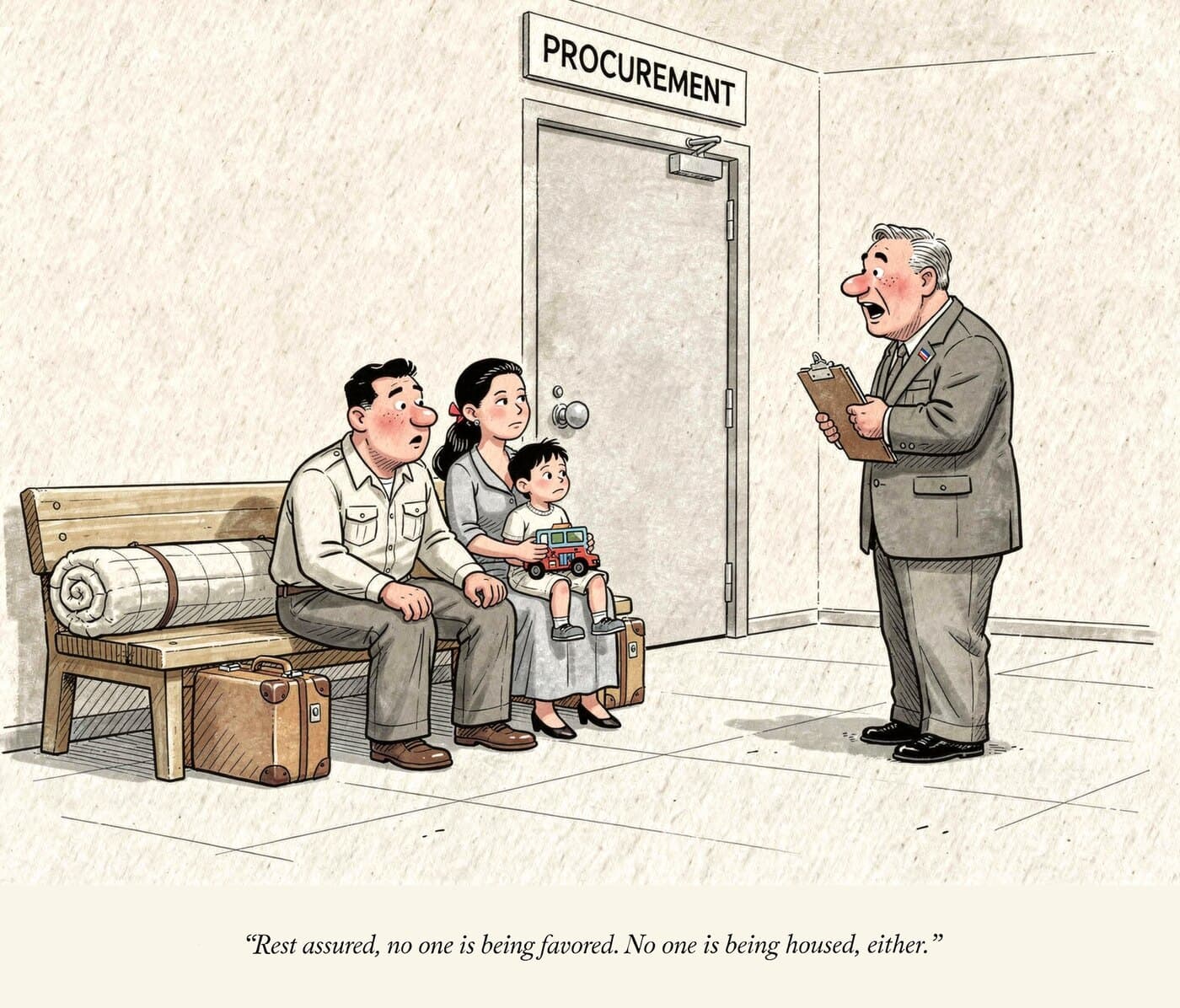
On Sunday evening I listened to the gubernatorial debate the way many of us did, half attentive and half hopeful, waiting for a particular word. The candidates spoke about affordability, about permits, about the cost of living that presses on every household here. But the word I was listening for never quite arrived. It was own. Not rent more cheaply, not qualify for assistance, not wait for a unit to open. Own: a key that belongs to you, to a door that will still be yours when your children are grown.
I know that word can be an ordinary expectation. When I lived and worked in Singapore, I came to understand that most of the people I passed each morning were going home, in the evening, to flats the state had built and they themselves owned. That was not luck. In 2024, nearly ninety-one per cent of Singapore's resident households lived in homes they owned, and about three in four lived in public housing.1 The program that made this possible began in 1964, when the state started selling its flats to the people who lived in them.2
Guam's arithmetic runs the other way. A government study identified a need for 9,908 additional housing units between 2020 and 2025, for the civilian community alone.3 The island's housing authority manages 751 public units.4 Meanwhile, the Navy is seeking 2,400 units from the private market for its own personnel, 1,317 of them by mid-2028.3 Add those to a civilian shortfall that no published count has shown closing, and Guam needs roughly eleven thousand homes in about two years. A young family here is not competing with a neighbor for a home so much as with the clock. We will not close that gap by asking the old machinery to run faster.
Here is what surprised me when I looked closely at how Singapore builds. Its housing board does not pour the concrete itself. It puts construction out to bid among private contractors, as we do. The difference is in how. Contractors must be registered, rated, and experienced before they can bid; the board spreads work so that no firm is overstretched; and bids are scored on both price and quality.5 When two contractors collapsed mid-project in 2021, the board installed replacements in about a month, rather than the three or four months a fresh round of bidding would have taken, because the bench was already built.6 And every government contract put out to bid is posted on a single public portal, along with who won it, for how much, and for which agency.7
That is procurement made fast by design and honest by default.
Guam's procurement law was modeled on a code that the American Bar Association approved in 1979.8 It was written for a world of carbon copies and filing cabinets, a world in which the only way to prevent favoritism was to slow everything down until every step could be witnessed. Those rules were not foolish. They exist because public money was misused, and because the people deserved to see how their government spent. The purpose of procurement was never paperwork. It was trust.
We are now paying for that trust in time, and still not getting it. At a procurement summit last year, the general manager of the Guam Power Authority described a solar and battery project held up for two years by a protest, the formal challenge a losing bidder can file.9 And the process hides a quieter trap: it stalls when one party simply does not act. Late last year, a bidder on the Simon Sanchez High School project filed the first of three protests with the Department of Public Works. The protest alone froze the project. With none of the three decided, the bidder appealed to the Office of Public Accountability. The hearing officer dismissed it. Guam law allows an appeal only from a protest decision, and none had been issued, so there was nothing for the office to rule on.10 No one broke a rule. The rules let the clock stop.
Training matters. But no amount of training can shorten a process that is slow by design, or move a step that the law requires and no one is compelled to take. GovGuam cannot train its way out of this. It cannot procure its way out of a procurement problem.
So I would ask the next administration, whoever the voters choose, to return to first principles. Why did we build these rules? To prevent waste, favoritism, and secrecy. Then ask a harder question: which of those dangers can now be guarded against by tools that did not exist in 1979? A contract can be published the hour it is signed. A project can report its spending and progress every week to a page any resident can open on a phone. Sunlight that once required a clerk and a cabinet can now be automatic.
Once the work is visible, a different kind of competition becomes possible. Let the government's own teams, the people who already know our roads and our soil, take on the work and report openly on its cost and pace. Then invite any firm that believes it can do the same work faster or for less to bid on the next phase. Have the bids judged by someone with no stake in either, and let the better offer win.
In the nineteen-nineties, Indianapolis let city departments bid against private companies for public work, beginning with a contract to repair potholes.11 By the former mayor's account, the city ran about eighty such competitions; some were won by public employees, and some by private firms.12 The point was never to punish government workers. It was to give the good ones a fair chance to prove it, and to give residents the best work their money could buy.
Speed also depends on what we choose to build. Eleven thousand homes in two years will not come from crews pouring one house at a time. They can come from factories. Korea's public housing corporation, LH, has been assembling apartment blocks from modules made off-site. At a 416-unit project in Sejong, each module was set in about thirty minutes, and a twenty-two-story modular tower is now rising in Uiwang.13 The method is not yet cheaper; in 2024, LH's chief executive put the premium at about thirty per cent, with LH aiming to match the conventional price by 2030.13 Its advantage is time, the one thing Guam's families no longer have. Here, such buildings would have to withstand typhoons and earthquakes, and prove it before the first module ships. And once they stand, they should be sold to the families who live in them, at subsidized prices that adjust to each household's income, as Singapore does.14
If private insurers will not cover a kind of building they have never seen, that hesitation should not become the bottleneck. Hawaii once filled a gap like this. After Hurricane Iniki, most private insurers stopped covering property there, and mortgage lenders began foreclosing. In 1993 the state created its own hurricane fund, and in 2000, once private insurers had returned, the fund stopped writing new policies.15 That is what government is for: carrying a risk the market is too cautious to take, until the market is ready to take it back.
I am a newcomer here, and I am careful about what I presume to know. But I do know what a key means to a family. It means a child who does not change schools every year. It means grandparents who can stay close. It means the dignity of tending something that is yours.
I was raised to believe that the measure of leadership is how it treats the household with the least room, and that a promise kept quietly is worth more than one made loudly. Whoever takes the oath in January will inherit a housing shortage that does not care which party wins, and it will not arrive alone. Guam's troubles are many, and they will not yield to old remedies in new slogans. They call for pragmatic leaders who look past the solutions we have always reached for and act on what can be done now. Begin with one building: made in a factory, built for our typhoons, its costs posted every week, and sold to the families who move in. Not in two or three years, after another study and another round of protests. Now.
I hope that person will look past the lines that divide us, sit down with the people who can actually build, and open the work to the light. The families waiting for a door of their own have been patient long enough.
Footnotes
-
Singapore Department of Statistics, "Resident Households — Latest News & Data" (owner-occupied resident households, 90.8% in 2024; HDB dwellings, 77.2% in 2025). https://www.singstat.gov.sg/find-data/explore-data-themes/households/resident-households/latest-news-data ↩
-
National Library Board, Singapore, Infopedia, "Housing and Development Board" (HDB began selling flats under a homeownership scheme in 1964). https://eresources.nlb.gov.sg/infopedia/articles/SIP_1589_2009-10-26.html ↩
-
Pacific Island Times, "Navy seeks to tap Guam's private sector to supply 2,400 military housing units." https://www.pacificislandtimes.com/post/navy-seeks-to-tap-guam-s-private-sector-to-supply-2-400-military-housing-units ↩ ↩2
-
The Guam Daily Post, "GHURA says now's not the time to build public housing developments." https://www.postguam.com/news/local/ghura-says-now-s-not-the-time-to-build-public-housing-developments/article_18f0ea02-f92f-11ee-bbda-436351b23561.html ↩
-
Singapore Ministry of National Development, "Written answer on selection criteria for main contractors of HDB BTO projects," September 18, 2023. https://www.mnd.gov.sg/newsroom/speeches/view/written-answer-by-ministry-of-national-development-on-selection-criteria-for-main-contractors-of-hdb-bto-projects ↩
-
Housing & Development Board, "New Contractors Appointed," press release, September 29, 2021. https://www.hdb.gov.sg/about-us/news-and-publications/press-releases/29092021---New-Contractors-Appointed ↩
-
GeBIZ, "Singapore Government Procurement Regime" (tender and quotation notices posted on GeBIZ, which also carries tender awards). https://www.gebiz.gov.sg/singapore-government-procurement-regime.html ; Singapore Ministry of Finance, "Government Procurement via GeBIZ" (dataset of tenders and awards). https://data.gov.sg/dataset/government-procurement ↩
-
Pacific Island Times, "So many rules, so little time: Navigating Guam's procurement maze," July 3, 2025. https://www.pacificislandtimes.com/post/so-many-rules-so-little-time-navigating-guam-s-procurement-maze ↩
-
The Guam Daily Post, "Procurement reform summit sparks debate over solutions." https://www.postguam.com/news/local/procurement-reform-summit-sparks-debate-over-solutions/article_15bb2984-dba3-46cd-83c6-41965f35254a.html ↩
-
The Guam Daily Post, "OPA dismisses SSHS appeal," June 2026. https://www.postguam.com/news/local/opa-dismisses-sshs-appeal/article_0ebcfe74-9190-46de-adcc-63cc57b4b94f.html ↩
-
Harvard Kennedy School Case Program, "Mayor Stephen Goldsmith: Organizing Competition in Indianapolis (B)," 1995. https://case.hks.harvard.edu/mayor-stephen-goldsmith-organizing-competition-in-indianapolis-b ↩
-
Governing, "Public vs. Private Employees: Who Wins in a Bidding War?" https://www.governing.com/columns/smart-mgmt/col-public-private-employees-who-wins.html ↩
-
The Korea Times, "LH bolsters modular-based construction to lower defect risks," July 8, 2024. https://www.koreatimes.co.kr/business/companies/20240708/lh-bolsters-modular-based-construction-to-lower-defect-risks ; Sateconomy, on LH's 22-story Uiwang Chopyeong modular apartments (construction begun late 2024, completion expected around July 2027), April 18, 2025. https://sateconomy.co.kr/news/view/1065576390561329 ↩ ↩2
-
MyNiceHome (Housing & Development Board, Singapore), "CPF Housing Grants for HDB Flat Buyers" (grants tiered by household income, with lower-income households receiving larger amounts; up to S$120,000 for eligible first-timer families). https://www.mynicehome.gov.sg/get-started/hdb-grants-guide/ ↩
-
Honolulu Star-Bulletin, on the Hawaii Hurricane Relief Fund, December 9, 2000. https://archives.starbulletin.com/2000/12/09/news/story1.html ↩