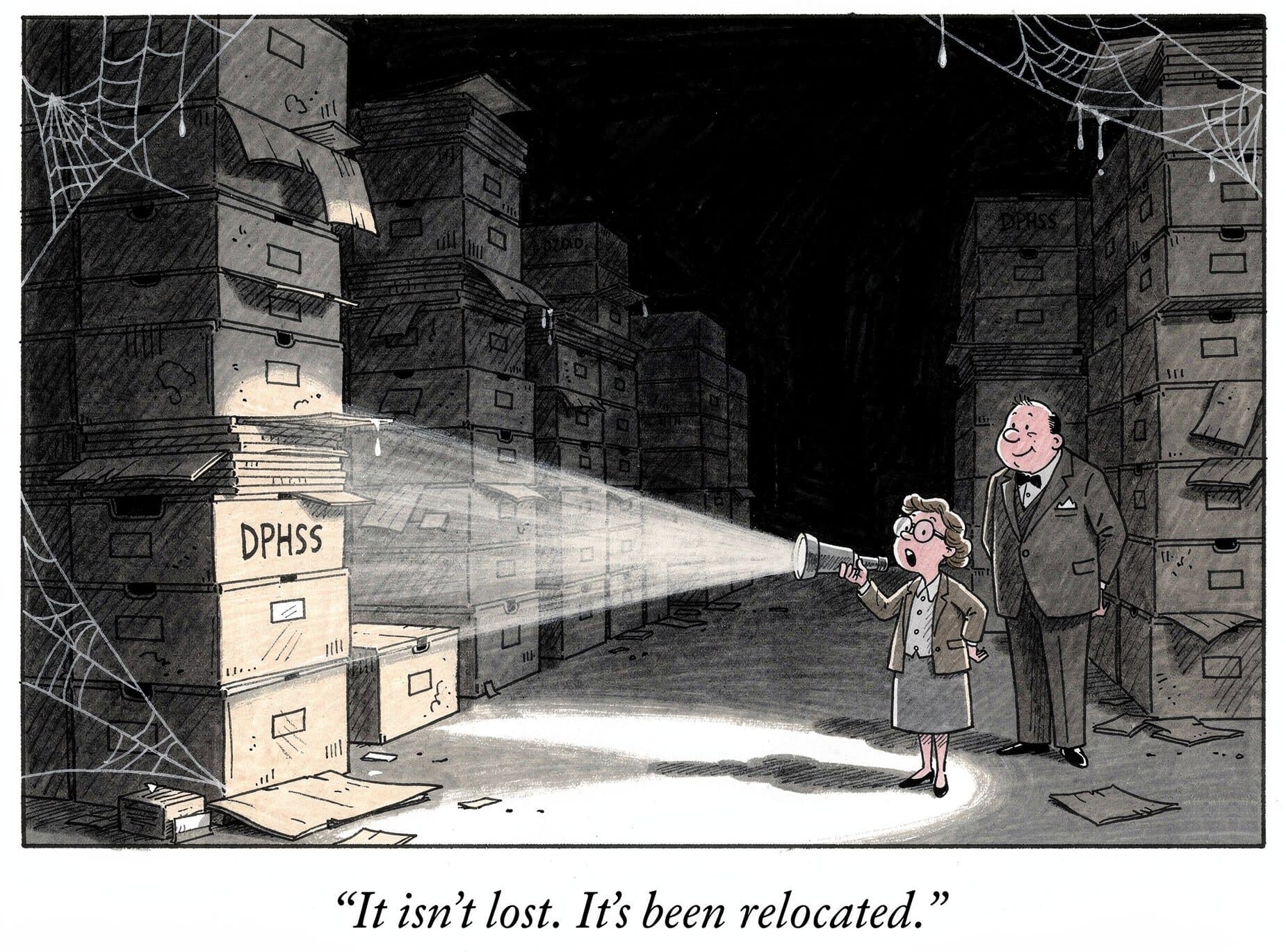
There is a file somewhere in the Department of Public Health and Social Services. Or there was. When auditors went looking for it — hunting for documentation behind hundreds of millions of dollars in Medicaid payments — they found boxes that had been "relocated to storage," databases nobody had updated in years, signatures that simply were not there.1 No drama. No villain. Just a government that had stopped keeping track.
That is the quiet scandal. Not theft. Indifference to the record.
The numbers that followed were not quiet. Guam's Office of Public Accountability examined $399.6 million paid to 218 Medicaid providers and flagged $241.1 million as questionable — not because the money was necessarily stolen, but because the paperwork to prove it wasn't had rotted away.2 Some providers had gone eight to ten years without the federally mandated five-year revalidation. The auditors, with the measured language of people who have seen this before, wrote that their findings "need management's attention and corrective action to inspire the public's confidence."
Inspire confidence. As if confidence were a feeling to be summoned rather than a result to be earned.
This is the pattern. Not a crisis, exactly — crises get fixed. This is something more corrosive: a government that keeps receiving the same diagnoses and shrugging them off.
Guam's Office of Public Accountability has now issued six status reports on its own recommendations. The latest found 28 of 83 recommendations from 2022–2023 audits still unaddressed. Going back further, 74 more recommendations from 2016–2021 remain open.3 The auditors found the same things everywhere they looked: broken billing systems, vanishing revenues, programs nobody was watching. Their conclusion — that government managers "have not recognized the importance and benefits of implementing effective internal controls" — reads less like a finding than a tired sigh.
The Department of Education offers the sharpest case study in what this costs. In its FY2024 financial audit, Ernst & Young found $1.92 million in over-depreciated buildings, $1.48 million in unrecorded lease liabilities, and no formal process for tracking whether federal funds were even recoverable.4 Twelve million dollars in available federal grants — money earmarked for children with disabilities, for early intervention programs — went unspent because GDOE couldn't manage the paperwork in time.5 The FY2023 audit was filed 129 days late. FY2024 missed its deadline too.5
Consider what that looks like at ground level. When OPA auditors arrived to examine DPHSS Medicaid records, they were told that files had been "relocated to storage." Not destroyed — relocated. The documents existed somewhere, in boxes the auditors couldn't reach.1 Some provider eligibility files had last been reviewed during the Obama administration. Nobody had flagged them. Nobody had a system that would. The agency's own database, auditors found, did not reflect reality — it reflected whatever had last been entered, whenever that happened to be.2 This is not a portrait of malice. It is a portrait of an institution that had been asked to manage public resources without being given the tools to do so — and had quietly adapted to that condition over many years, until the adaptation became the institution.
For decades, the connective tissue of GovGuam's finances was an IBM AS/400 — a computing platform IBM released in the summer of 1988, the same year the Seoul Olympics aired and Rain Man was in theaters. It processed payroll, tracked expenditures, and served as the government's institutional memory. Auditors examining the Guam Homeland Security Office eventually noted, almost as a footnote, that the AS/400 couldn't even flag when federal grants were about to expire.6 That single omission contributed to $6.3 million in lapsed grants and an $8.4 million hole in the General Fund.6
A government managing public safety and federal emergency funds on Reagan-era software is not cutting corners. It is governing without instruments.
GovGuam is finally replacing it. A $31 million Financial Management Information System contract with Performa Inc. began its phased rollout in 2024.7 The rollout has been rocky — training struggles, change orders, delays on the federal accounting module. That's expected with a transition this large. What isn't acceptable is that it took thirty-plus years to get here. The U.S. Government Accountability Office has documented what happens when agencies let legacy systems fester: outdated code, dwindling expertise, security vulnerabilities with no patches coming.8 Guam had all of that, governing a population of 170,000 with strategic importance to the entire Indo-Pacific.
Here is the thing about transparency that its opponents never say out loud: it works. Not as an abstraction. As a mechanism. Governments that invest in accessible, accurate data see less waste, faster error correction, higher public trust. The OECD has found that governments failing to adapt their data practices to modern expectations risk "a consequent diminishing of public trust."9 The corollary is just as true: when data is accessible and accurate, accountability becomes structural, not seasonal.
Guam is not standing still. The OPA's mobile app puts audit reports, procurement appeals, and a fraud hotline in residents' palms.10 Guam Public Law 33-93 requires the Bureau of Statistics and Plans to publish quarterly economic data.11 A $155.6 million federal broadband commitment is coming, which could finally build the infrastructure that a real data strategy requires.12 And the Centers for Medicare and Medicaid Services has committed $39 million specifically to modernize the Medicaid system that produced the $241 million mess — updating databases, digitizing records, building something fit for purpose.13
These are real. They are also overdue. None of them mean much if the underlying commitment — to record, store, and publish — doesn't take hold as a governing philosophy rather than a compliance checkbox.
The stakes are not abstract. Between FY2024 and FY2028, roughly $7.3 billion in U.S. military construction is planned for Guam.14 The Treasury Inspector General, reviewing Guam's use of CARES Act relief funds, concluded that "Guam's risk of unallowable use of funds is high" — not because of bad intentions, but because the documentation systems to prove proper use simply weren't there.15
The pattern is not mysterious. It is the predictable cost of governing without a ledger.
The fix is not glamorous. No ribbon-cuttings. No new programs with names on them. It is integrated data systems across agencies, common record-keeping standards enforced rather than suggested, and OPA recommendations treated as the floor of acceptable governance rather than advisory opinions. It is finishing the FMIS properly, extending that logic to procurement and grants, and making the resulting data searchable by any resident who cares to look — without filing a FOIA request to find out where their money went.
Before the next highway. Before the next housing program. Before the next federal grant lands in an account nobody is watching: get the data right. Know what you have. Know what you owe. Know what you spent.
You cannot fix what you refuse to see.
Guam deserves a government that knows what it has, says what it spent, and earns the trust of the people it serves. That work begins not with a new program or a new budget — but with a record, kept faithfully, and left in the light.
SK102 builds custom software for GovGuam agencies and local businesses — with local engineers who stay accountable after delivery. If your organization is dealing with outdated systems or audit findings that require better data infrastructure, start a conversation.
Footnotes
-
Office of Public Accountability, Guam. OPA Report No. 25-03: DPHSS Medicaid Program – Provider Eligibility – Part I. February 2025. https://www.opaguam.org/sites/default/files/opa2503.pdf. See also: Guam Daily Post. "OPA audit of Guam Medicaid eligibility files show missing paperwork, signatures." February 3, 2026. https://www.postguam.com/news/local/opa-audit-of-guam-medicaid-eligibility-files-show-missing-paperwork-signatures/article_26350076-5fc7-4763-b587-ed4d78d32e6e.html ↩ ↩2
-
OPA Report No. 25-03, ibid. See also: KUAM News. "Audit finds $241.1M in questionable Medicaid payments." 2025. https://www.kuam.com/story/52434838/audit-finds-dollar2411m-in-questionable-medicaid-payments ↩ ↩2
-
Guam Daily Post. "OPA: 28 audit recommendations still open from 2022, 2023 audits." September 23, 2025. https://www.postguam.com/news/local/opa-28-audit-recommendations-still-open-from-2022-2023-audits/article_a14c9abb-3103-4b33-82a8-520738b1541f.html ↩
-
Marianas Variety. "Audit: Guam Department of Education mismanaged millions." January 5, 2026. https://www.mvariety.com/regional/regional-audit-guam-department-of-education-mismanaged-millions-tr9w9kgh/article_300dc930-520a-4ad4-a294-5cb86a6bd118.html ↩
-
KUAM News. "OPA releases GDOE Fiscal Year 2024 audit." 2025–2026. https://www.kuam.com/story/53349997/opa-releases-gdoe-fiscal-year-2024-audit ↩ ↩2
-
Office of Public Accountability, Guam. OPA Report No. 24-07: Guam Homeland Security/OCD – Operating Costs Series, Part I. June 2024. https://opaguam.org/sites/default/files/opa2407_rev.pdf ↩ ↩2
-
Guam Daily Post. "Concerns with new GovGuam financial management system." February 11, 2025. https://www.postguam.com/news/local/concerns-with-new-govguam-financial-management-system/article_c2a863ce-003f-11ef-9b04-77db5ece1a0e.html. See also: KUAM News. "New financial system for GovGuam will be more efficient and paperless." https://www.kuam.com/story/50730817/new-financial-system-for-govguam-will-be-more-efficient-and-paperless ↩
-
U.S. Government Accountability Office. IT: Agencies Need to Plan for Modernizing Critical Decades-Old Legacy Systems. GAO-25-107795. 2025. https://www.gao.gov/products/gao-25-107795 ↩
-
OECD. The Path to Becoming a Data-Driven Public Sector. OECD Digital Government Studies, 2019. https://doi.org/10.1787/059814a7-en. The report identifies public trust as a core pillar of data-driven governance, finding that how governments manage and share data directly shapes citizen confidence — and that "any failure to adapt to this new and changing environment could expose them to damaging risks and a consequent diminishing of public trust." ↩
-
Office of Public Accountability, Guam. OPA Mobile App. https://www.opaguam.org ↩
-
Bureau of Statistics and Plans, Government of Guam. The BSP's official website states directly: "Pursuant to Guam Public Law 33-93, the Bureau of Statistics and Plans (BSP) and the Department of Agriculture (DoAg) are required to collect and publish quarterly data on the volume of imported agricultural [goods]." https://bsp.guam.gov/ ↩
-
Office of Delegate James Moylan. "Guam to Receive Over $155 Million to Improve Communications Infrastructure." January 2, 2026. https://moylan.house.gov/media/press-releases/guam-receive-over-155-million-improve-communications-infrastructure ↩
-
Governor of Guam. "Guam Medicaid Transformation Underway with $39M Federal Investment." August 28, 2025. https://governor.guam.gov/press_release/guam-medicaid-transformation-underway-with-39m-federal-investment/ ↩
-
Congressional Research Service. Guam: Defense Infrastructure and Readiness. CRS Report R47643. https://www.congress.gov/crs-product/R47643 ↩
-
U.S. Treasury, Office of Inspector General. Government of Guam CRF Final Desk Review Report. December 2, 2024. https://oig.treasury.gov/system/files/2024-12/Government-of-Guam-CRF-Final-Desk-Review-Report-12.2-(Locked).pdf ↩