
 By Samuel S. Kim
On the first Saturday in May, anyone who typed the Governor of Guam’s web address got no press releases, no office hours, no photograph of Adelup. They got a hacker’s boast, and under it a single word with a question mark: “Security?”1
Other government sites appeared to be offline: Revenue and Taxation, the Police Department, Labor, Agriculture, Parks and Recreation. The Governor ordered an assessment of every potentially affected agency.12 Homeland Security found no confirmation that residents’ personal information had been compromised.2 Still, the taunt was a fair question, and it was aimed at all of us.
The attackers had come in through cPanel, software that hosts websites around the world. Its maker had released a fix 4 days earlier.3 The flaw had likely been exploited since February, long before any fix existed, and more than 40,000 servers worldwide were compromised in the same wave.4 The episode shows how the race is run now: a fix appears, and the clock starts. Guam’s own AI task force has warned that artificial intelligence is shortening that clock, shrinking the time between a flaw’s discovery and its use against us.5 What matters, then, is whether the institutions meant to answer can move as quickly as the people asking.
In December 2025, the Legislature created the Guam Artificial Intelligence Regulatory Task Force (AITF), and it first met the following March.6 Its members include agency directors, a university president, hospital and judiciary officials and private-sector technologists, people with other jobs to do.7 They have formed 8 subcommittees, delivered a first progress report to the Governor and the Speaker, and produced ideas worth keeping. One would give residents a right to a meaningful human review whenever an automated system shapes a government decision about them. Another would bar vendors from training their AI models on government data.7 Those belong in law.
Read the minutes in order, though, and a pattern appears. In July, 2 subcommittees recommended naming one official accountable for AI and taking a 90-day inventory of the AI agencies use. At the same meeting, the chair asked that the draft survey be made simpler, less “scary,” so employees would actually fill it out. A member then reminded the room that any survey had to be approved by the University of Guam’s review board before it could go out.8 Each step was reasonable. Together, they cost a season. By September the inventory had become 2 survey proposals, still unreleased. No official had been named, no procurement or acceptable-use standard adopted, no pilot program put on record.7 The second progress report was due on November 17.9 A week later it still wasn’t among the documents posted on the Legislature’s website.10
It would be easy, and wrong, to blame the people in the room. The law makes the task force advisory. Its job is to recommend frameworks to the executive and legislative branches, not to deploy anything.611 Naming an owner, buying tools and patching servers are executive decisions. The task force can say what should be done. It cannot do it, and no one in the executive branch has yet been asked to.
In the 1960s, Fred Brooks managed the operating system for IBM’s System/360 and learned a lesson he spent the rest of his career explaining. Adding people to a late software project, he wrote, makes it later.12 Part of the reason is arithmetic: every person added multiplies the conversations. The 12 voting members alone make 66 possible pairs.13 Brooks also had a way of making the point stick: nine women, he observed, cannot produce a baby in one month.
His remedy was to split large efforts into small teams, and on paper the subcommittees do exactly that. What undoes the benefit is everything around them. Their work has nowhere to land except the full task force, which meets every other month, so a decision that needs the whole group can wait 2 months for its turn. In September the subcommittees had to adopt “focus points” just to keep from overlapping.7 And much of what they are drafting already exists: contract clauses, surveys, checklists. The GovAI Coalition, led by the City of San José, publishes an AI policy template, a vendor agreement and an incident response plan, and invites any government to take them.1415 Writing originals by committee is the slow road, and it is the one Guam is on.
The governments moving faster share something besides money: someone owns the work. In April 2025, the federal government gave every agency 60 days to name a Chief AI Officer and required each to publish an inventory of its AI uses every year.16 Pennsylvania began with a year-long pilot: 175 employees using ChatGPT Enterprise at work. Participants reported saving an average of 95 minutes a day, so the state widened access to more than 3,000 employees.171819 It did so under a governing board, and with a separate agreement protecting its unionized workers.20 Singapore put a secure AI assistant in front of its public officers without waiting for an AI law, and about four in five of its 150,000 officers have used it.21 None of these governments is reckless. Each picked an owner, started small and published what it learned.
Some will point to the task force’s $25,000 budget and the complexity of the rules.5 Others will worry, fairly, that moving fast with AI could itself expose residents’ data. But the protection against that is the very thing Guam lacks: an owner, an inventory, and contracts that bar vendors from training on government data. Those make speed safe. Neither worry is a reason to wait to learn what software the government runs, to name who answers for it, or to install a fix that has already been published. The attackers are not waiting. In November 2025, Anthropic reported a state-sponsored espionage campaign in which AI did 80 to 90 percent of the attack work.22
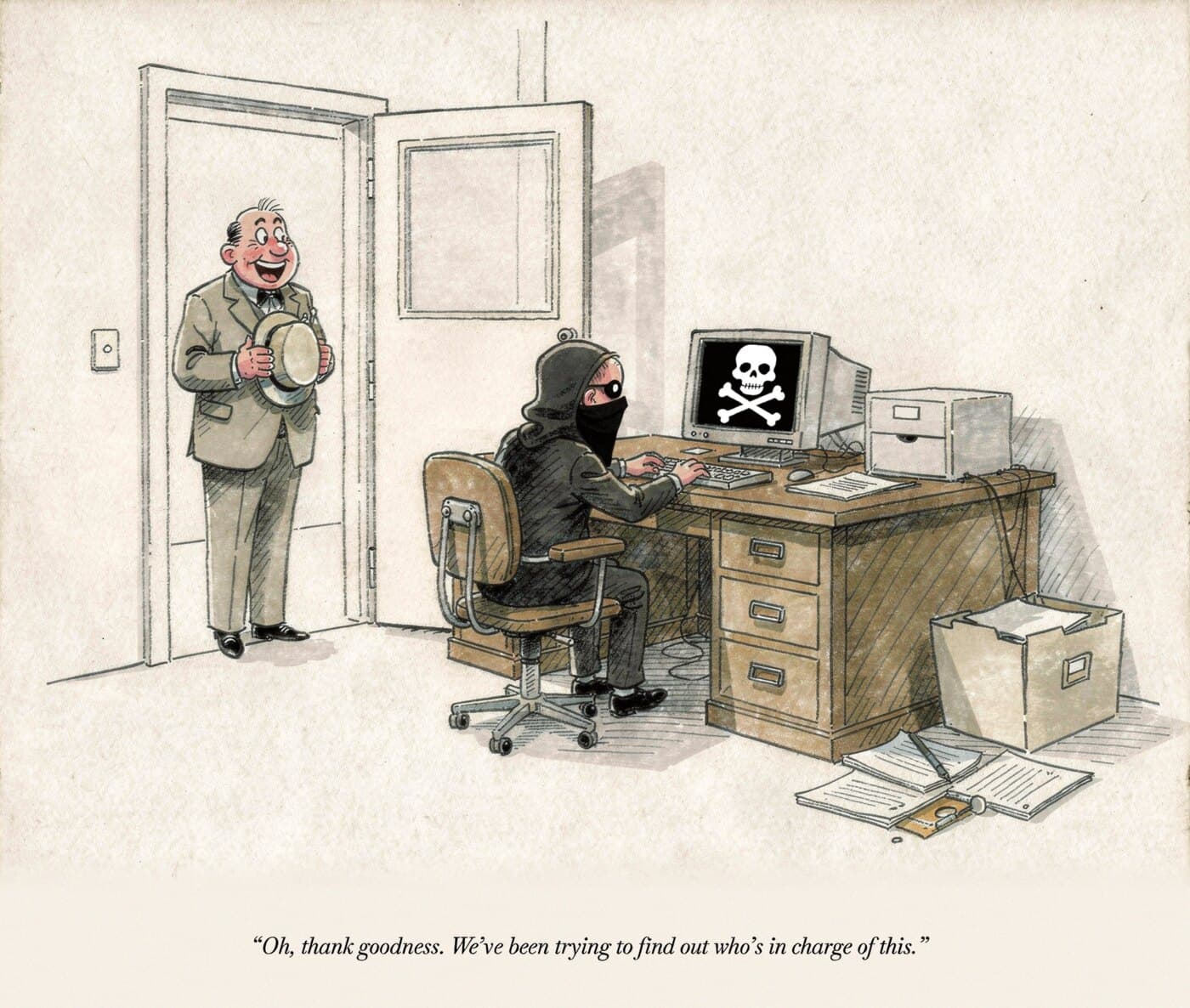
Some of these attackers have patient sponsors. In 2023, Microsoft reported that Volt Typhoon, a state-sponsored group based in China and active since mid-2021, had been targeting critical-infrastructure organizations in Guam. It worked quietly, using its victims’ own tools to avoid notice.2324 Groups like that don’t leave a taunt on a homepage; they stay and they watch. A government that couldn’t keep its own public websites intact, and that still has no inventory of the systems it runs, cannot honestly say what may already be leaving those systems unnoticed. Against adversaries with that kind of backing, a glacier’s pace was never going to be enough.
A new administration takes office on January 4.25 It would not need a single new statute. Within its first 60 days, it could name one official to own AI. It could give that person a small staff, with the task force as a review board. It could put patching on a 2-week clock, adopt templates other governments have tested, and send out a short inventory survey with a promise to publish the answers. And it could measure what employees do with the Gemini and Copilot access the government has.5 The Legislature could then amend the law so the task force advises that official directly, and its careful work would finally have a place to land.
The people who would feel the difference are not technologists. They are the residents waiting on a permit, a tax refund or a hospital report, and the public servants who might win back the kind of hours Pennsylvania’s employees reported saving. And the island has little time to spare. The Census Bureau projects that Guam will end the century with about 38 percent fewer people than it has today, as birth rates fall and more people leave than arrive.26 Visitor arrivals, battered this year by typhoons and fewer flights, ended fiscal 2026 at 57.8 percent below their pre-pandemic level.2728 A government that moves this slowly may find, when it is finally ready, that many of the people it meant to serve have already gone.
I keep coming back to that one-word taunt. “Security?” is a question that no law can answer on its own. In the end, a person has to answer it, someone able to say of the government’s systems: this is mine to look after, and I will. What Guam needs now is someone willing to say that sentence.
Footnotes
-
Kandit News, "Guam Governor's Office, Multiple Agency Websites Hacked," May 2026. https://kanditnews.com/guam-governors-office-multiple-agency-websites-hacked/ ↩ ↩2
-
Isla Public Media, "Multiple GovGuam websites hacked after global internet security flaw," May 3, 2026. https://www.islapublic.org/news/2026-05-03/multiple-govguam-websites-hacked-after-global-internet-security-flaw ↩ ↩2
-
Help Net Security, "cPanel zero-day exploited for months before patch release (CVE-2026-41940)," Apr 30, 2026. https://www.helpnetsecurity.com/2026/04/30/cpanel-zero-day-vulnerability-cve-2026-41940-exploited/ ↩
-
SecurityWeek, "Over 40,000 Servers Compromised in Ongoing cPanel Exploitation," May 4, 2026. https://www.securityweek.com/over-40000-servers-compromised-in-ongoing-cpanel-exploitation/ ↩
-
Guam AI Regulatory Task Force, First Progress Report, July 17, 2026. https://www.investguam.com/wp-content/uploads/2026/AI%20Task%20Force/First%20Progress%20Report%20for%20the%20Artificial%20Intelligence%20Regulatory%20Task%20Force%20(1).pdf ↩ ↩2 ↩3
-
Public Law 38-77, 38th Guam Legislature. https://guamlegislature.gov/38th_Guam_Legislature/Public_Laws_38th/Public%20Law%2038-77.pdf ↩ ↩2
-
AITF Minutes, September 21, 2026. https://www.investguam.com/wp-content/uploads/2026/AI%20Task%20Force/September/AITF_minutes_09212026.pdf ↩ ↩2 ↩3 ↩4
-
AITF Minutes, July 27, 2026. https://www.investguam.com/wp-content/uploads/2026/AI%20Task%20Force/July/AITF_minutes_07272026.pdf ↩
-
AITF Agenda, September 21, 2026. https://www.investguam.com/wp-content/uploads/2026/AI%20Task%20Force/September/GUAM%20ARTIFICIAL%20INTELLIGENCE%20REGULATORY%20TASKFORCE%20SEPT.%2021%2C%202026%20AGENDA%20.docx.pdf ↩
-
Guam Legislature, Messages and Communications (checked Nov 25, 2026). https://guamlegislature.gov/messages-and-communications/ ↩
-
5 GCA Chapter 17, Guam Artificial Intelligence Regulatory Taskforce. https://law.justia.com/codes/guam/title-5/division-1/chapter-17/ ↩
-
"Brooks's law," summarizing Fred Brooks, The Mythical Man-Month (Addison-Wesley, 1975). https://en.wikipedia.org/wiki/Brooks%27s_law ↩
-
Steven J. Zeil, "Team Organization" (lecture notes), Old Dominion University. https://www.cs.odu.edu/~zeil/cs350/s14/Public/staffing/staffing__html.html (A group of n people forms n(n − 1)/2 possible pairs.) ↩
-
City of San José, "Government AI Coalition." https://sanjoseca.gov/your-government/departments-offices/information-technology/ai-reviews-algorithm-register/govai-coalition ↩
-
GovAI Coalition, Annual Report for 2025 (City of San José). https://sanjoseca.gov/home/showpublisheddocument/109728/638472421287570000 ↩
-
OMB Memorandum M-25-21, April 3, 2025. https://www.whitehouse.gov/wp-content/uploads/2025/02/M-25-21-Accelerating-Federal-Use-of-AI-through-Innovation-Governance-and-Public-Trust.pdf ↩
-
Pennsylvania Office of Administration, "ICYMI: Shapiro Administration's Generative AI Pilot for State Workers Leads to Significant Time Savings," 2025. https://www.pa.gov/agencies/oa/newsroom/icymi--shapiro-administration-s-generative-ai-pilot-for-state-wo ↩
-
Pennsylvania Office of Administration, "Shapiro Administration Expands Artificial Intelligence Collaboration with CMU," 2025. https://www.pa.gov/agencies/oa/newsroom/shapiro-administration-expands-artificial-intelligence-collabora ↩
-
Pennsylvania Office of Administration, "Shapiro Administration Expands Safe and Responsible AI Across State Government," Apr 15, 2026. https://www.pa.gov/agencies/oa/newsroom/shapiro-admin-expands-safe-responsible-ai-improve-services ↩
-
The Philadelphia Inquirer, "As Pennsylvania implements AI tools for government employees, efficiency is the goal, not job cuts," Aug 10, 2026. https://www.inquirer.com/politics/pennsylvania/pennsylvania-state-government-employees-ai-tools-protections-20260810.html ↩
-
Singapore Ministry of Digital Development and Information, reply to Parliamentary Question, Nov 5, 2025. https://www.mddi.gov.sg/newsroom/mddi-s-response-to-pq-on-progress-of-adopting-ai-tools-within-public-service/ ↩
-
Anthropic, "Disrupting the first reported AI-orchestrated cyber espionage campaign," Nov 13, 2025. https://www.anthropic.com/news/disrupting-AI-espionage ↩
-
Microsoft Threat Intelligence, "Volt Typhoon targets US critical infrastructure with living-off-the-land techniques," May 24, 2023. https://www.microsoft.com/en-us/security/blog/2023/05/24/volt-typhoon-targets-us-critical-infrastructure-with-living-off-the-land-techniques/ ↩
-
Voice of America, "Microsoft Says China-Backed Hacker Targeted Critical Infrastructure in Guam, US," May 24, 2023. https://www.voanews.com/a/microsoft-says-china-backed-hacker-targeted-critical-infrastructure-in-guam-us/7107770.html ↩
-
48 U.S.C. § 1422 (the Governor's term begins the first Monday of January following the election). https://www.govinfo.gov/link/uscode/48/1422 ↩
-
U.S. Census Bureau, "Falling Fertility and Outmigration Drive Long-Term Declines for Some of the Largest U.S. Island Territories," Nov 5, 2026. https://www.census.gov/library/stories/2026/11/estimates-show-population-decline.html ↩
-
Guam Visitors Bureau, "Preliminary Visitor Arrival Summary, September 2026" (fiscal-year totals; GVB notes that 2025/2026 figures may exclude Armed Forces sea arrivals). https://guamvisitorsbureau.com/sites/default/files/september_2026_preliminary_arrival_summary_-_2.pdf Fiscal 2026 arrivals totaled 688,599, down 5.6 percent from fiscal 2025 and 57.8 percent below fiscal 2019 (1,631,049). ↩
-
Guam Visitors Bureau, "Preliminary Visitor Arrival Summary, October 2026," published Nov 1, 2026. https://guamvisitorsbureau.com/sites/default/files/october_2026_preliminary_arrival_summary_0.pdf October 2026 arrivals were 36,531, down 40.9 percent from October 2025. ↩