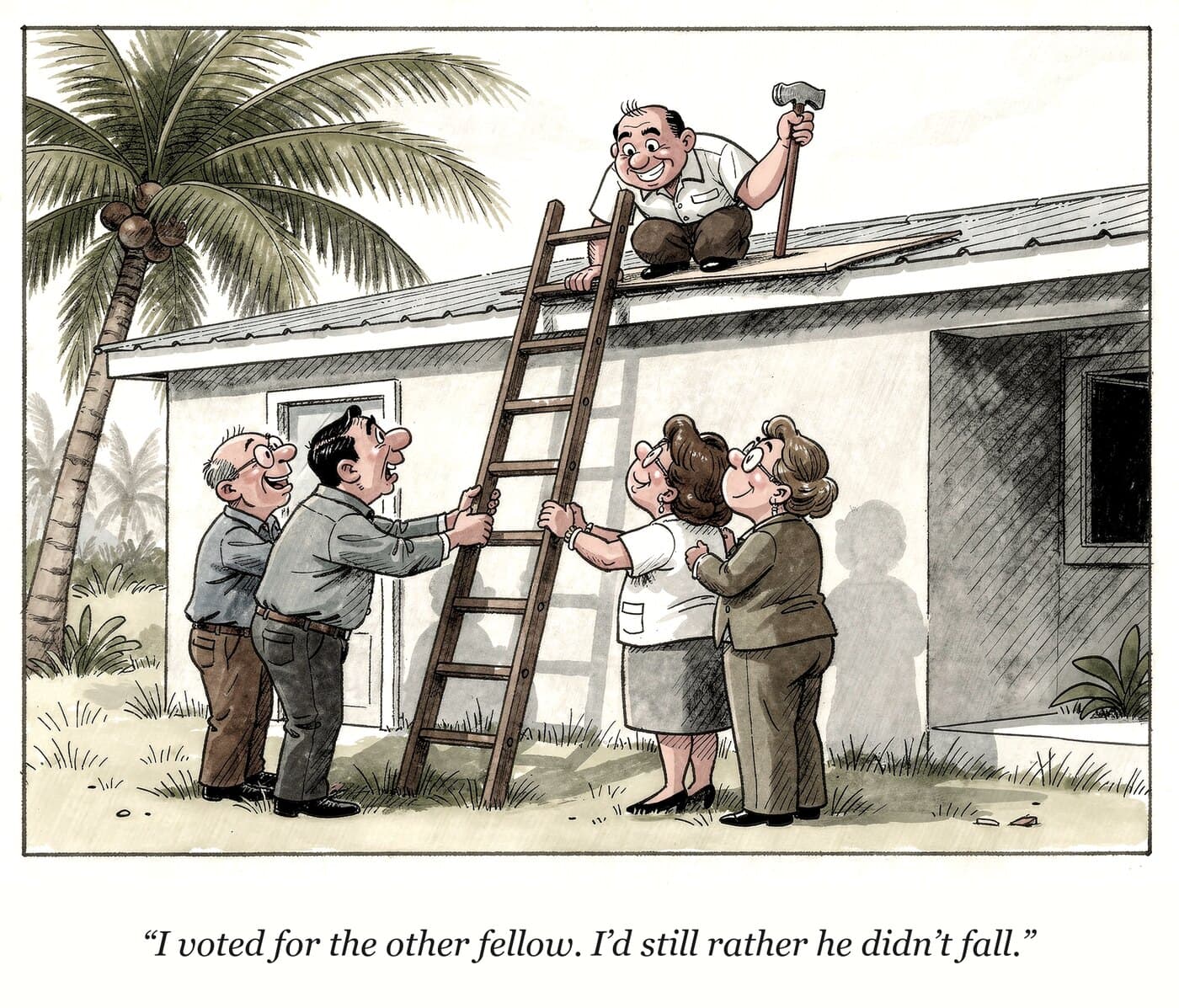
On the morning after an election, Guam looks exactly as it did the morning before. Traffic thickens on Marine Corps Drive at the usual hour. The roadside signs, which for months argued with one another at every intersection, are still standing, a little sun-faded, now addressed to no one.
What has changed is inside us. On November 3, a little more than half of Guam's registered voters went to the polls.1 The governor's race was decided by roughly a thousand votes, 15,945 to 14,925 in the unofficial count, and the Legislature appears to have split eight to seven.2 Numbers like these describe an island almost evenly divided. They also mean that nearly fifteen thousand of our neighbors woke up on Wednesday having lost what they had hoped for, sometimes desperately: a person they believed would finally work on their behalf.
If you are among them, part of this is written for you. If you are celebrating, part of it is written for you, too.
Disappointment is not the only thing a campaign leaves behind. For some, on either side of the result, there is also an aftertaste: the sense that voters were misled, and misled on purpose. I am in no position to rule on any particular ad, and spin is not lying. But a claim its sponsors know to be false, put before voters in order to move them, steals the one thing democracy rests on: a real choice.
Socrates, in Plato's Republic, complained that democracy dispenses "a sort of equality to equals and unequals alike."3 In a modern voting booth, that means the well-informed and the misinformed each get one vote. Yet none of us should feel superior. Psychologists have found that a false statement, merely repeated, starts to seem more believable even to people who know better.4 The right response, then, is not contempt for those who believed. It is a calm insistence on the record, pursued through the proper channels wherever wrongdoing can be proven.
The people who won were chosen, in the end, by the neighbors who cared enough to weigh the options and show up. That is never everyone, but it is the system we have all agreed to live under, and those taking office will shape the life of every resident for the next two to four years. So I would ask something that will feel, for some readers, like too much: give them the benefit of the doubt until there is proof otherwise. Assume that they looked at the path Guam is on, did not like where it led, and asked for the job because they believe the path must change.
Some whose candidates lost will object: why should I extend good faith to people I believe won unfairly? It is the strongest objection, and I do not want to wave it away. My answer is that trusting an office does not require settling who misled whom. Where wrongdoing can be proven, it should be pursued, whoever benefited. But believing a thing happened is not the same as proving it, and until there is proof, withholding cooperation punishes no one who did wrong. It only makes the next four years harder for everyone who lives here.
Those whose candidates won have a part in this, too. A margin of a thousand votes is a reason for humility, and good faith is far easier to give when it is not demanded. Nor is any of this a surrender of judgment. Scrutiny remains every citizen's duty, whoever is in office, and I intend to keep doing mine. It simply carries more weight when it begins in good faith.
Giving the benefit of the doubt is easy while nothing has changed. The test comes later, on the day a decision made at Adelup reaches into something of our own: an office reorganized, a familiar process replaced, a service delivered differently than it has been for as long as anyone remembers. On that day the question will no longer be whether we trust them in general. It will be whether we trust them with this.
Most of us know the feeling from smaller things: the new manager, the new system at work, the store that moved everything to a different aisle. We bristle first and evaluate later. Change, even necessary change, arrives as a threat long before it arrives as a promise. Economists have measured it. In a landmark 1988 paper, William Samuelson and Richard Zeckhauser showed that people cling to the existing option far more often than its merits justify, even in weighty decisions like health coverage and retirement savings.5 We hold on to what we know, not because it is good, but because it is ours.
But we cannot ask the people we elected to turn the island around and also ask them to leave everything we are used to in place. If the path must change, some of what is familiar must change with it. Some of those changes will be mistakes, and we should say so when they are. Many will simply be uncomfortable, and discomfort is not the same as harm. There are fair questions to ask of any change: Was it explained? Who bears its cost? Can it be undone if it fails? A change that can answer them deserves our patience, even when it is not the one we would have chosen.
Those who work inside the government will feel this first, though the question applies to anyone who has ever held a job, because every job is somebody's system. If my work changes in the name of better service to the public, the right question is not "How do I protect my position?" but "What else can I do to make lives better?" And there is a more uncomfortable question, one each of us should ask quietly: Have I become the bottleneck? Have I made myself necessary by keeping things slow, by holding knowledge in my head instead of building it into the process? It is a very human impulse. The need for security is legitimate. But a job secured by obstruction is a fragile kind of security, and the public pays for it: in hours spent waiting at a counter, in lives put on hold for a desperately needed permit, and, sometimes, in a family that gives up and leaves the island.
None of this runs in one direction. The incoming administration owes the same good faith to those already doing the work. The employees who kept the counters open and the systems running, often with less than the work required, are not obstacles to reform. They are its supply line. Their fear of change is not disloyalty. It is the same pull toward the familiar that all of us feel, made sharper when a paycheck, and the family it feeds, depends on how the change turns out.
So explain before you reorganize. Tell people what will happen to their jobs before they hear it from a rumor; on an island this size, the rumor usually arrives first. Train them for the government you intend to build rather than discarding the institutional memory you will soon need. Take care of those who stayed, and many of them will gladly do the new work beside you.
The signs will come down soon, and with them, I hope, the sides. Winning gracefully is easy. Losing gracefully is harder. Hardest of all is what follows both: forgiving what can be forgiven, pursuing what must be pursued, and turning toward the neighbor who voted the other way.
The election is over. There is no longer a red team and a blue team on this island. There is one team, and last week we chose who will lead it. So I will ask one more thing, of those who cheered and those who grieved alike: stand behind the people we elected, long enough and firmly enough to let them do the work. That is not blind loyalty; honest questions are part of being a good teammate. The next four years will go a long way toward deciding whether Guam turns around or keeps sliding in the direction so many of us have watched with worry. No administration can make the changes this island badly needs over the resistance of the very people it is making them for. It will take all of us, pulling the same way.
Footnotes
-
KUAM News, "53% voter turnout in general election," November 4, 2026. https://kuam.com/story/370524850/53-voter-turnout-in-general-election ↩
-
Unofficial returns as compiled by The Green Papers from Guam Election Commission data, "Guam 2026 General Election." https://www.thegreenpapers.com/G26/GU ; KUAM News, "Unofficial results show Ada-Calvo wins gubernatorial race," November 4, 2026. https://kuam.com/story/370525290/unofficial-results-show-ada-calvo-wins-gubernatorial-race ; KUAM News, "Republicans claim 8-7 majority for 39th Guam Legislature," November 4, 2026. https://kuam.com/story/370524851/republicans-claim-8-7-majority-for-39th-guam-legislature ↩
-
Plato, The Republic, Book VIII (558c), trans. Benjamin Jowett. MIT Internet Classics Archive. https://classics.mit.edu/Plato/republic.9.viii.html ↩
-
Lisa K. Fazio, Nadia M. Brashier, B. Keith Payne, and Elizabeth J. Marsh, "Knowledge does not protect against illusory truth," Journal of Experimental Psychology: General 144, no. 5 (2015): 993–1002. https://pubmed.ncbi.nlm.nih.gov/26301795/ ↩
-
William Samuelson and Richard Zeckhauser, "Status Quo Bias in Decision Making," Journal of Risk and Uncertainty 1, no. 1 (1988): 7–59. https://scholar.harvard.edu/files/rzeckhauser/files/status_quo_bias_in_decision_making.pdf ↩