On the ninth of August, 1965, Lee Kuan Yew went on television and wept. He had spent years arguing that Singapore belonged inside Malaysia; now Malaysia had voted it out, and he was left with a crowded island of migrants who shared no common language, no natural resources to speak of, and powerful neighbors who did not much care whether it survived.1 Years earlier, he had called the very idea of an independent Singapore an absurdity — political, economic, and geographic.2 He was, by his own reckoning, the leader of something that should not exist.
What he did have was a natural deep-water harbor at the tip of the Malay Peninsula, at a crossroads of East-West trade.3 And he had a conviction that there was no time to waste. Three years after independence, Britain announced that it would withdraw its forces, which had been spending roughly seventy million pounds a year on the island.4 Lee flew to London, argued, and threatened. He came home with a delay of nine months and about fifty million pounds in aid, largely soft loans — less than a single year of what the bases had been pouring in.5 Singapore did not spend the next decade waiting for a better deal. Its leaders studied what had worked elsewhere, adapted it without embarrassment, and built.6
Guam is not Singapore, and the strongest objection to the comparison is a fair one. Lee governed with a hand that many of his admirers prefer not to examine closely: a tamed press, a hobbled opposition, laws that would not survive an afternoon in an American courtroom. Guam belongs to a democracy and should stay that way. Nobody should be wishing for a strongman.
But the lesson worth carrying across the Philippine Sea is not the heavy hand. It is the clock. Lee's government behaved as though every month of delay carried a cost that someone, somewhere, would pay. Ours has too often behaved as though delay were simply the price of prudence. That price is not paid by the government. It falls on the families still waiting for the problem to be fixed, and on the businesses still waiting to be paid, wondering how they will cover next month's rent and payroll.
Guam, unlike Singapore, has never had to stand alone. Each year, the federal government returns to Guam the income taxes withheld from federal employees and service members stationed here — more than seventy-six million dollars for fiscal 2025 alone.7 During the pandemic, Guam was promised some six hundred million dollars in federal recovery funds, a sum equal to nearly two-thirds of the government's budget that year.8 As recently as last year, about a hundred and thirty-three million dollars of it remained unspent, earmarked for a new hospital project, while senators pressed to redirect it toward urgent repairs at the hospital we already have.9 Singapore in 1968 would have given a great deal to have a problem like that.
The Government of Guam is the island's largest single employer. As of June, it accounted for about eleven and a half thousand jobs — roughly one of every six on Guam.10 When it pays its bills on time, it teaches everyone that bills get paid on time. When it moves slowly, the whole island learns to move slowly.
This week, voters choose a governor and lieutenant governor, along with fifteen senators.11 I will not tell anyone whom to vote for. But I know the team I want.
At Adelup, I want a pair willing to set down the playbook they inherited, to ask why federal money is still sitting unspent years after it arrived, to fix what can be fixed now rather than perfectly later, and to plant a few things they will never be thanked for — so that people want to visit Guam, and stay, long after they have left office.
At the Legislature, I hope for senators who honor the old laws. The men and women who wrote them were solving the problems of their day with the tools of their day, and most did so in good faith. But honoring a law is not the same as never reopening it.
In 2017, Benny Benavente Bello of Koku Recycling went before the Legislature to ask, once again, to be paid. Some fifteen years earlier, after Supertyphoon Paka, his company had hauled away four decades' worth of junked cars and old appliances; the government still owed it seven and a half million dollars.12 Guam's Prompt Payment Act had called for interest on late government payments since the Eighteenth Legislature.13 A bill before the Thirty-Third had found that many small businesses cannot wait months to be paid, that some stop bidding on public work altogether, and that those who stay quietly raise their prices to cover the wait.14 Bello had waited fifteen years. He called it an injustice.12
The law was not wrong. It simply never received the teeth, the systems, or the attention that today's tools could give it. One of those tools costs almost nothing: post every agency's unpaid vendor bills online each month, oldest first, so that the Prompt Payment Act finally has a scoreboard.
A good law passed a year from now may arrive after the firm that could have carried it out has packed up. Small businesses — the contractor, the clinic, the independent consultant who could help an agency modernize — run on the next payment. A government that pays in ninety days instead of thirty is not merely inefficient; it is quietly deciding which of its own people get to stay. Every one of those departures is a skill, a payroll, and a family that Guam does not get back.
The oldest prompt-payment law I know of is not in Guam's code. It was given to a wandering people thousands of years ago, and it asked only this: pay the hired worker before the sun goes down, because he is counting on it.15
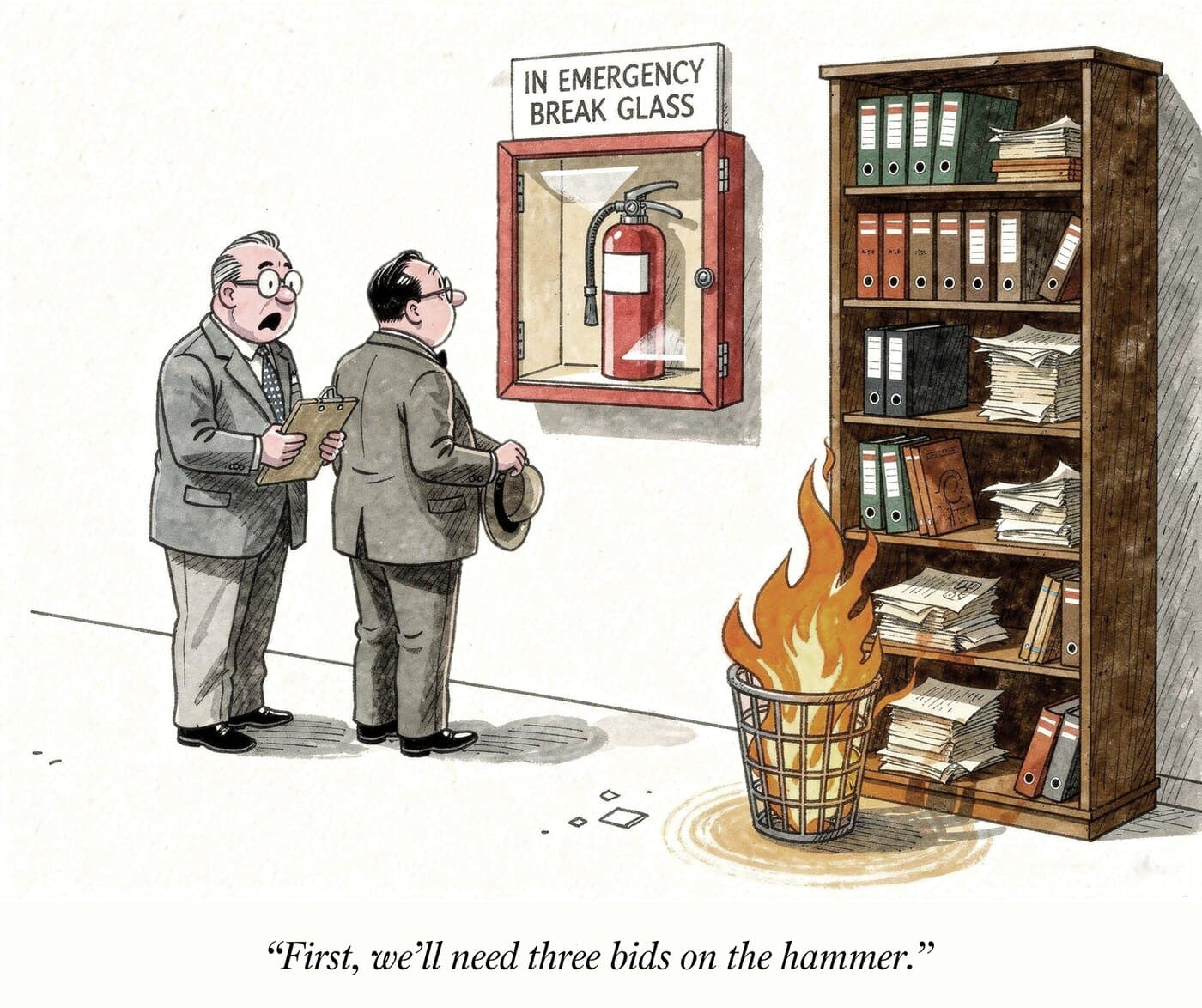
In June of 2023, a tanker truck caught fire beneath Interstate 95 in Philadelphia, and the roadway above collapsed into the flames.16 Within a day, Pennsylvania's governor had signed a disaster proclamation that set aside the usual bidding and contracting formalities — for twenty-one days, unless the state legislature extended it.17 Engineers chose a practical answer over a perfect one: recycled glass aggregate, paved over, to carry traffic while a permanent bridge went through the slower, ordinary work of design.16 Six lanes reopened twelve days after the collapse.18
The rules did not disappear; someone decided which of them could wait, because the people who depended on that road mattered more than the comfort of the familiar.
Singapore had a harbor, a location, and almost nothing else, and it treated every month as precious. A broken highway was rebuilt in twelve days. Whoever wins this week will have, at most, four years.19 Ask them what they will fix before the year is out, and what they will plant that Guam will still be harvesting long after they are gone.
Footnotes
-
Malay Mail (Reuters), "Obituary: Lee Kuan Yew, the benevolent dictator," March 23, 2015. Describes the 1965 expulsion, Singapore's lack of natural resources and common language, and Lee weeping on national television two days after the August 7 separation agreement. ↩
-
Dawn, "The Singapore model", 2015. Notes Lee's description of an independent Singapore as "a political, economic and geographic absurdity," and his government's practice of studying successful development models abroad. ↩
-
National Library Board Singapore, "Harbour at Tanjong Pagar," Memories of Two Cities; Derek Heng, "Continuities and Changes: Singapore as a Port City Over 700 Years," BiblioAsia, National Library Board Singapore, 2005. ↩
-
Government of Singapore, SG101, "#OnThisDay (29 Oct): Withdrawal of British Far East Command." Records the loss of some 30,000 British troops and £70 million a year in base spending. ↩
-
National Library Board Singapore, Infopedia, "British withdrawal from Singapore." Records the extension of the withdrawal deadline from March to December 1971 and the negotiated £50 million soft loan; see also Ministry of Defence Singapore, One of a Kind (2nd ed., 2015), p. 34. ↩
-
Dawn, "The Singapore model." ↩
-
Pacific Island Times, "Guam legislature sequesters $76.4M Section 30 funds," September 13, 2024. ↩
-
Pacific Island Times, "Guam finally receives $553M from ARPA," May 21, 2021 (total expected allocation of $604 million, equivalent to more than 63 percent of the government's $949 million 2021 budget); Office of the Governor of Guam, "GovGuam receives $553M for investment in the future." ↩
-
Pacific Island Times, "Guam senators race the governor for the remainder of Covid recovery funds," September 3, 2025 (about $133 million of unspent funds set aside for a new hospital project; nine senators seeking reallocation to repairs at Guam Memorial Hospital). ↩
-
Guam Department of Labor, Bureau of Labor Statistics, "Employment Indicators," June 2026 preliminary figures (Government of Guam: 11,520 of 67,930 total jobs); I Liheslaturan Guåhan, Bill No. 169-31 (COR), legislative findings (describing the government of Guam as "the island's largest employer"). ↩
-
The Green Papers, "Guam 2026 General Election" (general election Tuesday, November 3, 2026); Guampedia, "Guam Legislature" (fifteen senators since the 1998 election). ↩
-
The Guam Daily Post, "GovGuam leaves business with decade-old, unpaid $7.5M bill," September 2017 (testimony of Benny Benavente Bello of Koku Recycling; cleanup work after Supertyphoon Paka about fifteen years earlier; Bello called the unpaid obligation an injustice). ↩ ↩2
-
5 GCA Chapter 22, Article 5, "Interest on Late Payments by the Government" (Prompt Payment Act, enacted by P.L. 18-040), as reproduced in Guam Department of Administration FOIA response, August 8, 2024. ↩
-
I Liheslaturan Guåhan, Bill No. 127-33 (COR), legislative findings and intent. ↩
-
Paraphrasing the Mosaic law on wages; see Deuteronomy 24:14–15 and Leviticus 19:13. ↩
-
Axios Philadelphia, "The plan for rebuilding I-95," June 14, 2023 (tanker-truck fire; more than 15,000 cubic yards of recycled glass backfill). ↩ ↩2
-
Office of the Governor of Pennsylvania, "Governor Shapiro Signs Proclamation of Disaster Emergency Following the Collapse of the I-95 Overpass in Philadelphia," June 12, 2023 (waiver of bidding and contracting formalities; proclamation in effect for 21 days unless extended by the General Assembly); see also Office of the Governor of Pennsylvania, "Governor Shapiro Reopens I-95 in Philadelphia Twelve Days After Collapse" (permanent bridge design proceeding separately). ↩
-
Office of the Governor of Pennsylvania, "Governor Shapiro Reopens I-95 in Philadelphia Twelve Days After Collapse," June 23, 2023 (around-the-clock work; permanent bridge designed separately). ↩
-
The Green Papers, "Guam 2026 General Election" (Governor: four-year term). Senators in the Guam Legislature are elected biennially, in even-numbered years; see the Organic Act of Guam, 48 U.S.C. § 1423. ↩